How to follow up with a client without being pushy: method and message templates
A client who stops coming back has rarely made a decision: most of the time, they simply forgot. Here's how to follow up at the right time, with a short, useful message, without ever seeming pushy, plus ready-to-copy templates for your profession.
A client used to come every month, and now nothing for three months. She's probably not upset: she forgot, something came up, or she's simply waiting for a sign. Following up with a client who no longer comes back is part of every self-employed professional's job, but many hesitate for fear of being a bother. Done well, a follow-up doesn't feel like advertising: it's a service offered at the right time.
This guide gives you a method to know who to follow up with, when and through which channel, ready-to-copy message templates by profession, and the rules to follow so your messages stay welcome and compliant.
Why a client stops coming back
Before following up with a client, understand what happened. In the vast majority of cases, an inactive client hasn't made a decision. The most common reasons are simple:
- forgetting: without an appointment set in advance, the need takes a back seat to everything else;
- friction: they have to call during opening hours, and the moment never comes;
- a life change: moving, a new baby, a new job, a tight budget;
- disappointment: less common, but it happens, and it deserves to be heard.
The first three reasons can be solved with a well-timed message and a booking link. The last one calls for a different approach: a sincere question, with no sales offer. That's why a good follow-up doesn't push: it makes coming back easy and leaves the door open.
Who should you follow up with first?
Not all inactive clients are equal. Sort them into three groups to adapt your tone:
- Regulars who have drifted away: they came at a known rhythm and have gone past it. They're the easiest to bring back, and the ones who matter most.
- Clients who came once or twice: they don't know you well yet. A more explanatory message, reminding them what you offer, works better.
- Former clients you haven't seen in a long time: a single, warm message, without insisting.
Leave out your friends and family, your partners and anyone who has asked you not to contact them again. A well-organized client list, with categories, avoids these awkward mistakes.
When to follow up: the rhythm of each service
The right moment depends on the profession, and even on the service. A men's haircut isn't followed up at the same pace as an annual check-up. The rule: follow up just after the point when the client would normally have come back.
| Profession | Example service | When to follow up |
|---|---|---|
| Hairdresser | Regular haircut | A few weeks after the usual date |
| Beautician | Facial | After the rhythm recommended at the last treatment |
| Coach | Fitness coaching | After two to three weeks without a session |
| Wellness practitioner | Massage, sophrology | At a change of season, or before a busy period |
| Tradesperson | Annual servicing | One month before the anniversary date |
| Lawyer, consultant | Case follow-up | At a deadline that's useful to the client, never as an offer |
Adjust these guidelines using your own history: look at how often your loyal clients actually come back, and set your follow-up delay just beyond that.
Email, SMS or in person?
Each channel has its role. Email allows a fuller message, with a booking link, and costs little. SMS is read quickly, but it's seen as more intrusive: keep it short and save it for clients who are used to texting with you. Finally, a word in person remains the best tool: suggesting the date of the next appointment before the client leaves often avoids having to follow up at all.
Whatever the channel, write to a person, not a list: their first name, a reference to their last service, the usual tone of your relationship.
Follow-up message templates to copy
Hairdresser, email: "Hi {PRENOM}, it's been a while since we saw you at the salon. If you'd like to freshen up your cut before the holidays, there are time slots open online this week: [link]. See you soon, [your first name]."
Beautician, SMS: "Hi {PRENOM}, it's [first name] from the salon. It's been a little while since your last treatment: I've kept a few time slots open online for you here [link]. Have a lovely day!"
Coach, email: "Hi {PRENOM}, I haven't heard from you since our last session. No pressure: if you'd like to ease back in, I offer a tailored comeback session. You can choose your time here: [link]."
Tradesperson, email: "Hello {PRENOM}, your system was last serviced a year ago. To schedule the visit before winter, you can choose a time slot here: [link]. Kind regards, [business name]."
Client who came only once: "Hi {PRENOM}, thanks again for your visit. If you have any questions about [service] or would like another appointment, I'm here. My available times are here: [link]."
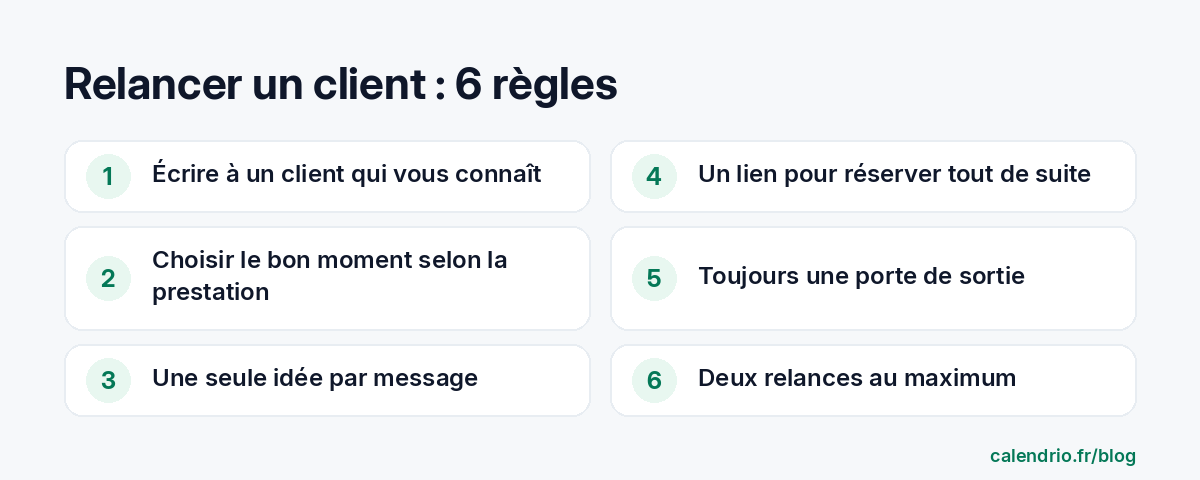
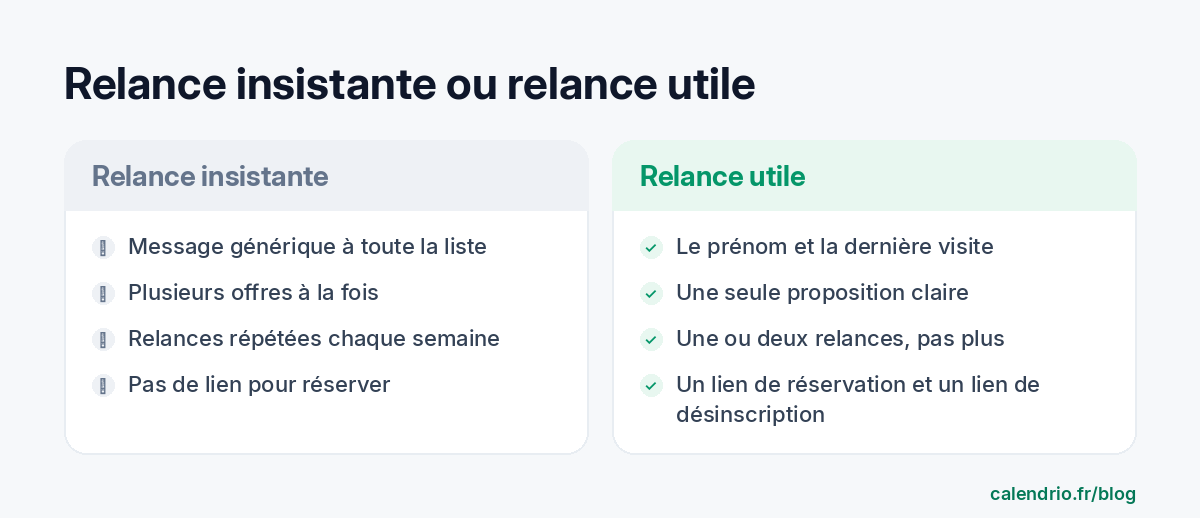
Notice what they have in common: a first name, a reminder of the context, a single suggestion, a link to act right away, and no guilt-tripping lines like "Have you forgotten about us?".
Should you include an offer?
A small gesture can help a client who is hesitating: a modest discount on the next service, a complementary treatment, a comeback session. But an offer isn't required. For a regular client, a simple "I've kept some time slots for you" is often enough. Avoid discounts in every message: your clients would learn to wait for the follow-up before coming back.
Some professions strictly regulate marketing communication. This is the case for legal professions and many health professions: check with your professional body or organization before offering a discount.
How many follow-ups, and when to stop?
To follow up with a client without wearing them out, plan one follow-up, then possibly a second a few weeks later if the client hasn't replied. Beyond that, attentiveness turns into pushiness. If the client replies that they no longer wish to come, simply thank them and remove them from your follow-ups. If you sense disappointment, ask an open question: "Is there anything I could have done better?" The answer is often worth more than an appointment.
Rules to follow for your messages
Following up with clients by email or SMS is regulated. The CNIL (the French data protection authority) points out that prior consent is in principle required to send marketing by email or SMS to private individuals. It also specifies that this consent isn't required to contact your own clients about products and services similar to those they've already bought, provided they can easily opt out.
The French Ministry of the Economy's website adds that every marketing message must clearly state the business's identity and offer a simple, free way to stop receiving messages, for example a link at the end of the message. These rules have nuances: for your specific situation, check the CNIL's pages or consult a legal professional.
- An inactive client has most often just forgotten: a well-timed follow-up helps them come back.
- Follow up first with your regulars who have gone past their usual rhythm.
- Set the follow-up delay for each service, not with a single rule.
- A good message fits in a few lines: first name, context, one suggestion, a booking link.
- Two follow-ups at most, a way out in every message, and compliance with the CNIL rules.
To go further, our guide to building client loyalty explains how to stop clients drifting away, and our guide to getting Google reviews shows how to turn a returning client into a recommendation.
How Calendrio helps you follow up with your clients
In Calendrio, under each service, in "Client follow-ups", you choose whether clients are followed up and after how many days, with an optional discount. The "To follow up" filter in My contacts then shows you who to contact. You check the clients, launch an email or SMS campaign, personalize the message with their first name and check the preview before sending. On paid plans and during the trial, your loyal clients can also automatically receive an offer of their usual time slot.
Every campaign message includes your booking link and an unsubscribe link; unsubscribed clients and your personal contacts are never followed up. The client chooses their own time online, 24/7. You can try these tools with the one-month free trial, no credit card and no commitment.
Frequently asked questions
How do you follow up with a client without being pushy?
How long should you wait before following up with an inactive client?
Am I allowed to send a follow-up email or SMS to my clients?
Should I offer a discount in a follow-up message?
What if your calendar filled itself?
With Calendrio, your clients book online 24/7 and receive automatic reminders. 1-month free trial, no credit card required.
Try Calendrio for free