Building client loyalty: 10 practical ideas for self-employed professionals
A client who comes back books on their own, at the right pace, and talks about you to others. Here are 10 simple things you can do to build client loyalty when you work alone, with examples by profession and ready-to-copy messages.
When you work alone, every client who comes back counts double: they cost nothing to find, they already know how you work and they talk about you to others. Yet most self-employed professionals put their energy into finding new clients and let the old ones go without a word. Building client loyalty takes neither an advertising budget nor a complicated points program. Above all, it takes consistency and a few well-placed gestures.
Here are 10 practical ideas, in the order of your clients' journey, with examples by profession and ready-to-copy messages.
Why focus on loyalty before looking for new clients?
A new client takes up your time before they even book: posts, answering questions, quotes, a longer first appointment. A loyal client books on their own, at the right pace, and recommends you. Bpifrance Création (the French public bank's support service for business founders) sums it up in its advice to entrepreneurs: continuously improving the client experience, listening to what clients say and bringing them value after the purchase are among the basic levers.
For a self-employed professional who lives on appointments, what's at stake is even more concrete: a regular client means a time slot filled in the coming weeks, with no prospecting effort. It also means a more predictable schedule, and therefore a more stable income.
Ideas 1 and 2: take care of the first appointment… and the day after
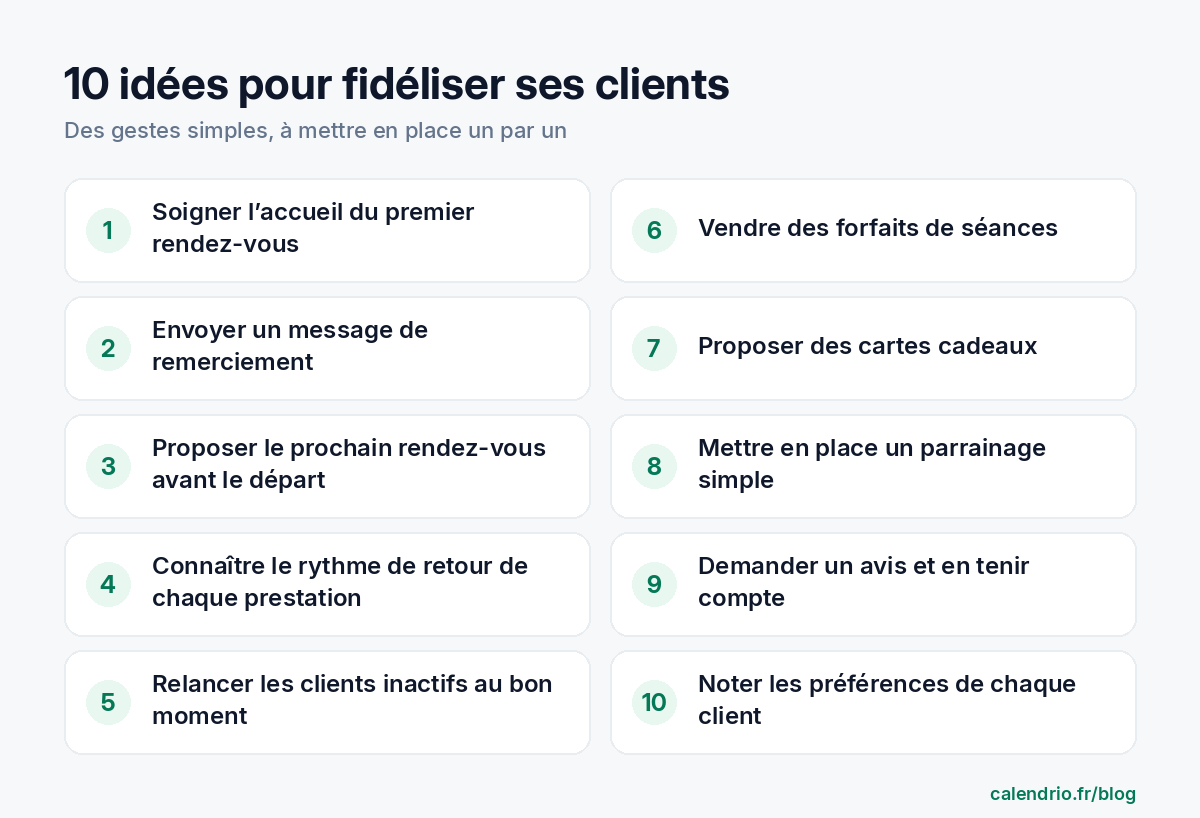
1. Take care of the welcome at the first appointment. The first visit often decides the second. A client who found the address easily, didn't have to wait and had what was going to happen explained to them already wants to come back. Send the practical information the day before: address, door code, parking, what to bring.
A few examples: a personal trainer can mention the clothing and the bottle of water to bring, a lawyer the list of documents to bring to the first meeting, a tradesperson access to the meter or the room concerned. This message avoids unpleasant surprises and shows the client they're dealing with an organized professional.
2. Send a thank-you message. A short message the same day or the day after shows that you remember the person. Add a useful tip linked to the service: what to avoid after waxing, which exercises to repeat after a physical therapy session, how to care for a haircut.
Thank-you message template:
"Hello Thomas, thank you for your visit today. Remember to drink plenty of water this evening after the session. If you have any questions at all, you can reach me by message. See you soon, [first name]."
Ideas 3 and 4: offer the next appointment at the right pace
3. Offer the next appointment before the client leaves. This is the most profitable and simplest idea. At the end of the appointment, the client is satisfied and available: offer them a date straight away. They can always move it later.
4. Know the return rhythm of each service. Every profession has its cycles. Write them down, service by service, based on your own experience:
| Profession | Service | When to offer another appointment |
|---|---|---|
| Hairdresser | Men's cut, color | When the regrowth or the shape of the cut starts to show |
| Beautician | Waxing, nails | According to each client's own growth |
| Personal trainer | Follow-up sessions | At the end of a package or a cycle of goals |
| Wellness practitioner | Massage, sophrology | According to the program agreed with the client |
| Tradesperson | Annual servicing | Shortly before the anniversary of the job |
For health professions such as physical therapists, the pace of sessions follows the prescribed treatment: loyalty then comes mainly from the quality of the welcome and how easy it is to book again. For a beautician, this rhythm is built directly into the schedule: see our guide to a beautician's schedule.
Idea 5: follow up with inactive clients, without being pushy
5. Follow up at the right time. A client who doesn't come back isn't necessarily unhappy: often they've simply forgotten. A well-timed message is often enough to bring them back. The key: write when the client needs it, with a personal tone and a link to book.
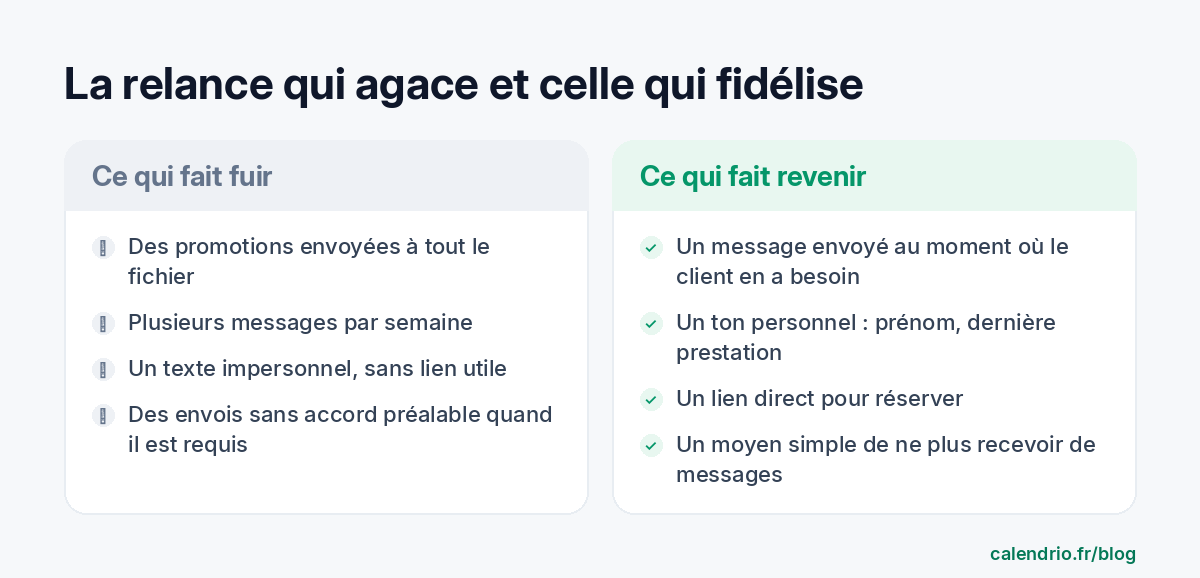
Template for following up with an inactive client:
"Hello Sophie, your last session was a few weeks ago. If you'd like to start again, I still have free time slots late on Tuesday and Thursday afternoons: [booking link]. Have a good week, [first name]. To stop receiving these messages, reply STOP."
Who to follow up with, after how long and with what words? Our method for following up with an inactive client without putting them off covers each case in detail, with message templates by profession.
Watch the legal framework. According to the CNIL (the French data protection authority), sending marketing messages by email or SMS to private individuals requires, in principle, their prior consent. There is an exception for your clients, when the message is about products or services similar to those they have already bought from you. In every case, each message must make it easy and free to opt out of future messages, and clearly identify the sender. For a specific case, refer to the CNIL's guidance or a legal professional.
Ideas 6 to 8: packages, gift cards and referrals
6. Sell packages of sessions. A package of five or ten sessions commits the client over time and gives you visibility. It suits coaches, wellness practitioners or beauticians who offer courses of treatment.
7. Offer gift cards. Your satisfied clients are your best ambassadors: a gift card lets them give your service to someone close to them, who becomes a new client already won over. Remember to promote it before the end-of-year holidays and Mother's Day.
8. Set up a simple referral program. No need for complex rules: "For every person you recommend to me, you get 10% off your next session." Choose a reward you can keep up without losing money, and write the rule down in black and white.
Ideas 9 and 10: listen and remember
9. Ask for a review and take it into account. Asking for a review shows that the client's opinion matters. Public reviews also reassure future clients on your Google Business Profile: our method for getting Google reviews after every appointment explains how to go about it. Read the mixed reviews too: they often point to what could drive other clients away.
10. Note each client's preferences. The children's names, the color formula, the painful area, coffee without sugar: these details, noted in the client's record, make them feel recognized at every visit. It's often what sets a self-employed professional apart from a big chain.
How do you know if your clients come back?
No need for sophisticated metrics. Once a quarter, ask yourself three questions:
- Of the clients who came for the first time in the previous quarter, how many came back at least once?
- How many regular clients haven't come back for longer than their usual rhythm?
- Where do your new clients come from: recommendations, Google, social media?
If the first answer drops, work on the welcome and the first appointment. If the second rises, work on follow-ups. If recommendations are rare, think about referrals and reviews. And to limit appointments lost along the way, also see our methods against missed appointments.
Mistakes that drive loyal clients away
- Keeping the best offers for new clients: your regulars notice.
- Sending too many messages: one useful message is better than four promotions.
- Making booking difficult: if booking again takes three phone calls, the client will go elsewhere.
- Forgetting clients between visits: a single useful message per quarter is enough to stay on their mind.
- Changing prices without warning: announce any increase in advance, simply.
- Building loyalty takes less energy than finding new clients and makes your schedule more predictable.
- Offer the next appointment before the client leaves, at the pace of each service.
- Follow up with inactive clients with a personal, useful message that complies with CNIL rules.
- Packages, gift cards and referrals turn your satisfied clients into ambassadors.
- Ask for reviews and note everyone's preferences.
How Calendrio helps you build client loyalty
In Calendrio, you choose for each service whether your clients receive follow-ups, after how many days and with what discount, if any. When a regular client hasn't booked again, Calendrio can offer them their usual time slot by email if it's free, and a Google review request is sent automatically after the appointment. The client file keeps the appointment history and your private notes; from the Calendar & CRM, you can also launch an email or SMS campaign (€0.10 excl. VAT per SMS). Gift cards and session packages can be sold online with the Pro and Team plans.
To see what's included in each plan, visit the Pricing page: the one-month free trial requires no credit card and no commitment.
Frequently asked questions
What is the simplest way to build client loyalty?
Am I allowed to send text messages or emails to my clients?
When should you follow up with a client who no longer comes back?
Is a loyalty program useful for a self-employed professional?
What if your calendar filled itself?
With Calendrio, your clients book online 24/7 and receive automatic reminders. 1-month free trial, no credit card required.
Try Calendrio for free