Cancellation policy: a template and clear rules for self-employed professionals
One client cancels at the last minute, another doesn't show up: without a written rule, every case becomes a negotiation. Here's how to write a cancellation policy that is clear, fair and easy to apply.
One client cancels their session an hour beforehand, another doesn't show up, a third arrives twenty minutes late. Without a written rule, every situation becomes a negotiation, often an awkward one. A clear cancellation policy settles the matter in advance: the client knows what they can do, until when, and what happens if they don't let you know. And you no longer have to improvise.
This guide gives you the elements to include, a guide to choosing your notice period by profession, the limits set by consumer law in France and a complete template to adapt.
What is a cancellation policy for?
A cancellation policy is a short text that sets the rules for cancellations, rescheduling, late arrivals and no-shows. It has three concrete effects:
- it protects your time: a time slot canceled early can be offered again, a time slot canceled at the last minute is almost always lost;
- it avoids arguments: you're applying a rule the client read before booking, not making a personal decision against them;
- it makes payment at booking easy to understand: if you ask for arrhes or an acompte, the client knows when they get it back.
It complements the other ways to fight no-shows (reminders, easy cancellation, waiting list), detailed in our guide to reducing missed appointments.
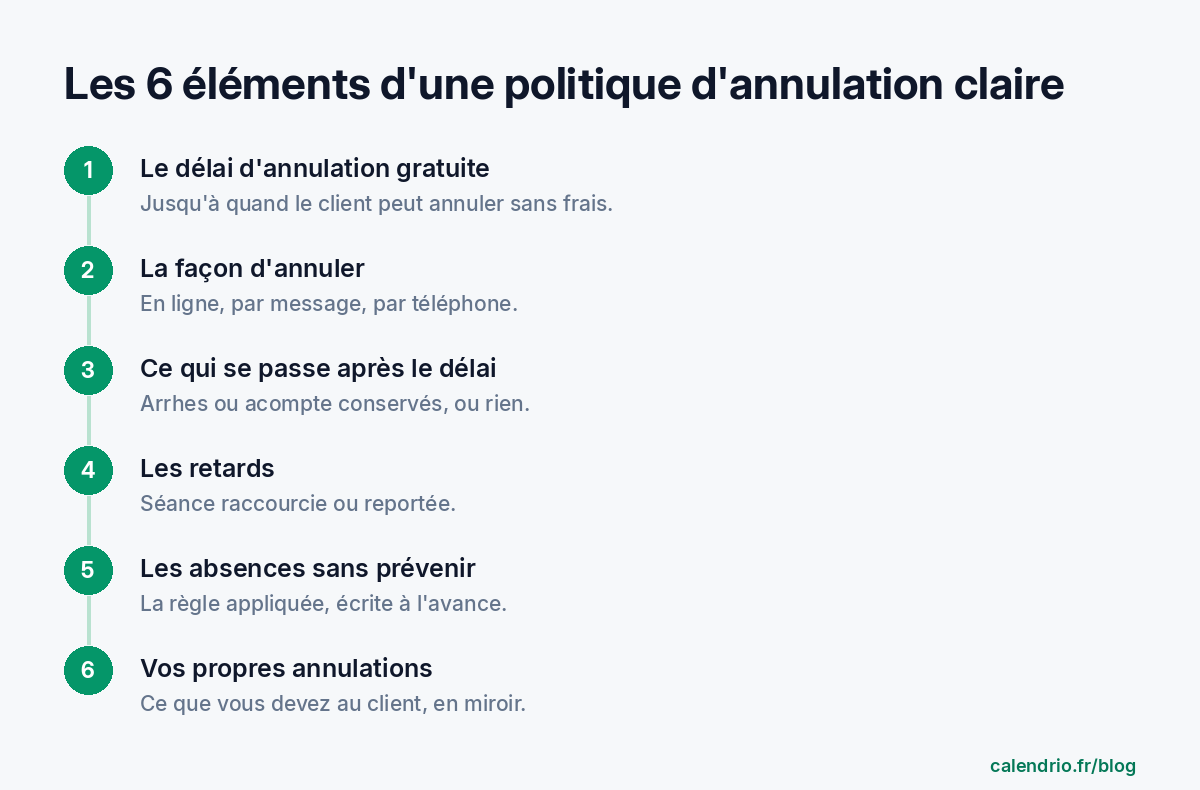
The 6 elements of a good cancellation policy
1. The free cancellation period
This is the heart of the rule: "up to 24 hours before", "up to 48 hours before", or "until noon the day before". Choose a wording the client can work out effortlessly. "24 hours before" is clearer than "one business day before".
2. How to cancel
State the accepted channel: the link in the confirmation email, the client account, a message, a phone call. The easier it is to cancel, the earlier clients let you know instead of simply not showing up. A client who has to call a closed salon to cancel may not let you know at all.
3. What happens after the deadline
Once the deadline has passed, what happens to the money paid? Arrhes kept, acompte kept, rescheduling allowed once, or no consequence if you don't ask for anything at booking. In France, the word you choose ("acompte" or "arrhes") changes each party's rights: our article acompte or arrhes explains the difference.
4. Late arrivals
A fifteen-minute delay on a one-hour session pushes back the rest of your day. Set a simple rule: the session ends at the scheduled time, or it's rescheduled beyond a certain delay.
5. No-shows without notice
The client doesn't come and doesn't answer. Write down what you apply in that case, even if it's the same rule as for a late cancellation. What's written in advance is easier to apply.
6. Your own cancellations
This is the most often forgotten point. Illness, a sick child, a breakdown: you may have to cancel too. Plan what you offer the client (priority rescheduling, full refund). This reciprocity makes your rule fairer, and it's also what consumer law looks at (see below).
Which cancellation notice to choose: 24 hours, 48 hours or more?
No standard notice period applies to every profession: it's generally up to you to set it, while respecting consumer rules. The right question is: how long do I need to fill this time slot if it's canceled?
| Type of service | Examples | Notice that often works |
|---|---|---|
| Short service, booked at short notice | Men's haircut, waxing, 30-min coaching session | 24 hours, or even the evening before |
| Long service that blocks half a day | Color and highlights, full facial, 90-min massage | 48 hours |
| Service prepared in advance or involving travel | Outdoor photo shoot, tradesperson visit at the client's home, wedding hairstyling | 72 hours or one week, depending on preparation |
| First appointment or assessment | Coaching assessment, first sophrology session | 24 to 48 hours, with online cancellation available |
These periods are guidelines, not standards: a hairdresser with a long waiting list can make do with 24 hours, while a wellness practitioner in a rural area will need more. You can also set a different notice period for each service: a single rule for a 20-minute treatment and a two-hour treatment is rarely fair.
What the law regulates (and what it lets you decide)
Your cancellation policy is a clause in your contract with the client. With private individuals in France, it must comply with the Code de la consommation (French Consumer Code). Here are the main points to know; for a specific case, have your terms reviewed by a lawyer, your chamber of commerce or trades, or your professional organization.
Sums paid in advance are, by default, "arrhes"
Under French law, if you ask for a payment at booking without specifying its nature, it's treated as "arrhes": a client who cancels loses it, and a professional who cancels pays back double. The details are in our guide acompte or arrhes.
An overly one-sided rule can be set aside
According to the DGCCRF (the French consumer protection authority), a clause is unfair when it creates, to the consumer's detriment, "a significant imbalance between the rights and obligations of the parties". An unfair clause is deemed unwritten: it doesn't apply. Two examples from the list of clauses presumed unfair relate directly to cancellation:
- imposing on the consumer a penalty "of a manifestly disproportionate amount";
- allowing the professional to keep the sums paid when the consumer withdraws, "without reciprocally providing for the consumer's right to receive compensation" if it's the professional who withdraws.
Hence the value of an amount proportionate to the price of the service, and of a rule that also covers your own cancellations.
Online bookings: the right of withdrawal
When a contract is concluded at a distance with a consumer, the French Consumer Code in principle provides a 14-day right of withdrawal, with exceptions (article L221-28). The DGCCRF also points out that a consumer who expressly asks for the service to start before the end of that period may owe fees for the service provided if they withdraw. In addition, since June 19, 2026, professionals who conclude distance contracts through an online interface must offer a function allowing this right to be exercised free of charge online; it doesn't create a new right, it makes the existing right easier to exercise. These rules depend on your activity: check with a legal professional whether they apply to you.
Cancellation policy template to copy
Here's a short template, to adapt to your services, your notice periods and the word you've chosen (arrhes or acompte).
Template to adapt:
"Cancellation and rescheduling. You can cancel or reschedule your appointment free of charge up to [24 / 48] hours before, directly from the link in your email or by writing to us at [address].
Late cancellation or no-show. After this deadline, or if you don't show up without notice, the [arrhes / acompte] of [amount or percentage] paid at booking will be kept. If no payment was requested, we may ask you to pay when booking your next appointments.
Late arrival. If you're late, the session ends at the scheduled time. Beyond [15] minutes late, we may offer you a new time slot.
If we have to cancel. If we're unable to make it, we'll let you know as soon as possible and offer you a new time slot as a priority or a refund of the amount paid (double, if it's arrhes)."
Read your text out loud: if it takes more than thirty seconds to understand, it's too long for your clients.
Late arrivals and no-shows: applying the rule without getting angry
A rule is only worth something if it's applied, but it works better when applied with tact. Three habits help a lot:
- remind clients of the rule before the problem: in the confirmation message and in the reminder the day before;
- apply the rule in writing, without judgment: the message describes the fact and the rule, not the client's behavior;
- keep some leeway: a loyal client's first slip can be forgiven once. Note it in their record so you stay consistent next time.
Message to copy after a no-show:
"Hi [first name], we didn't see you at your [time] appointment today. I hope everything is OK. As stated when you booked, the [arrhes / acompte] is kept for a no-show without notice. You can book a new appointment here: [link]. Have a nice day!"
Message to copy for a loyal client's late cancellation:
"Hi [first name], thanks for letting me know. The cancellation comes after the [24]-hour deadline, but it's the first time: as an exception, I'm rescheduling your appointment at no charge. Here are my next available times: [link]."
Where should you display your cancellation policy?
The client must see it before booking and paying, not after. The right places:
- on your booking page, just before confirmation;
- in the confirmation email, with the link to cancel or reschedule;
- in the reminder sent the day before;
- at the salon or practice reception, and on your website or Google profile.
A beautician can, for example, add a line at the bottom of every message: "Free cancellation up to 24 hours before, from this link." A tradesperson who travels will state it in their quote and in their job confirmation. To organize freed-up time slots, our method to build a beautician's schedule shows how to keep short time slots that are easy to fill.
Mistakes that make a cancellation policy ineffective
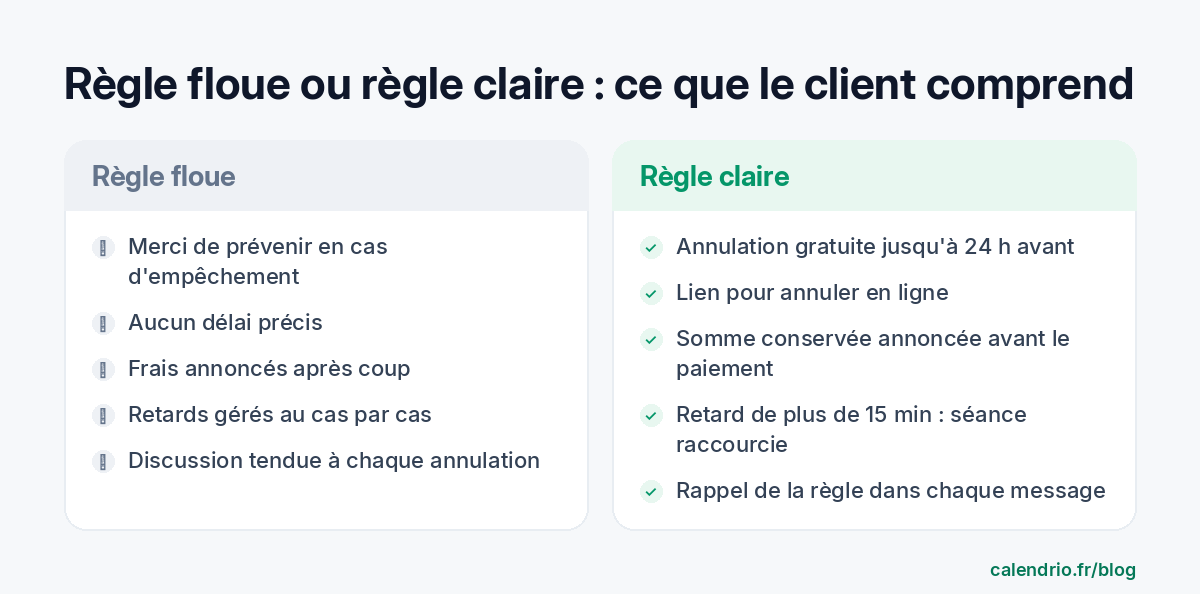
- A hidden rule: discovered when the client is charged a fee, it creates conflict instead of avoiding it.
- A rule that's impossible to follow: asking clients to cancel by phone when you don't pick up during sessions.
- A disproportionate penalty: charging the full price of a long service for a ten-minute delay.
- A one-way rule: nothing is planned when you're the one canceling.
- A rule that's never applied: clients quickly notice, and it loses all value.
- A cancellation policy sets out in advance the notice period, how to cancel, late arrivals, no-shows and your own cancellations.
- Choose the notice period based on how long you need to fill a freed-up time slot, service by service.
- With private individuals, keep the amount proportionate and the rule reciprocal: an unfair clause doesn't apply.
- For online bookings, check with a legal professional whether the right of withdrawal applies to you.
- Display the rule before booking, repeat it in every message and apply it with tact.
How Calendrio helps you apply your cancellation policy
In Calendrio, cancellation rules are set service by service. In "My services", the "Booking and cancellation" section lets you check "The client can cancel or reschedule online", set the notice period in hours and choose whether the deposit or payment is refunded for a cancellation made in time. After that deadline, the client can no longer cancel online and sees your contact details to reach you: you decide case by case. The automatic email reminder, sent 24 hours before (paid plans and trial), helps the client let you know in time.
You can test these settings on your own services with the one-month free trial, no credit card and no commitment.
Frequently asked questions
What cancellation notice should I set for an appointment?
Can I charge a client who doesn't show up to their appointment?
What should a cancellation policy include?
Where should I display my cancellation policy?
What if your calendar filled itself?
With Calendrio, your clients book online 24/7 and receive automatic reminders. 1-month free trial, no credit card required.
Try Calendrio for free- DGCCRF (economie.gouv.fr) — Clauses abusives : 12 clauses interdites et 10 clauses dont il faut démontrer la légitimité
- DGCCRF (economie.gouv.fr) — E-commerce : les règles entre professionnels et consommateurs
- Village de la Justice — Contrat à distance : la fonction de rétractation en ligne entre en vigueur le 19 juin 2026