Appointment reminder text templates: 13 messages ready to copy
A clear reminder sent the day before saves many lost time slots. Here are SMS reminder templates ready to copy, by profession and by situation, and the rules to keep them to a single SMS and make sure they're well received.
A client who forgets their appointment means a lost time slot that nobody else could book. A reminder sent the day before is still the simplest safeguard, as long as the message is clear, short and easy to read on a phone screen. Here you'll find appointment reminder text templates ready to copy, by profession and by situation, along with the rules to keep them to a single SMS and make sure they're well received.
All these templates are messages you send yourself, from your phone or your management tool. Adapt the words in square brackets, keep the tone you usually have with your clients, and you're done.
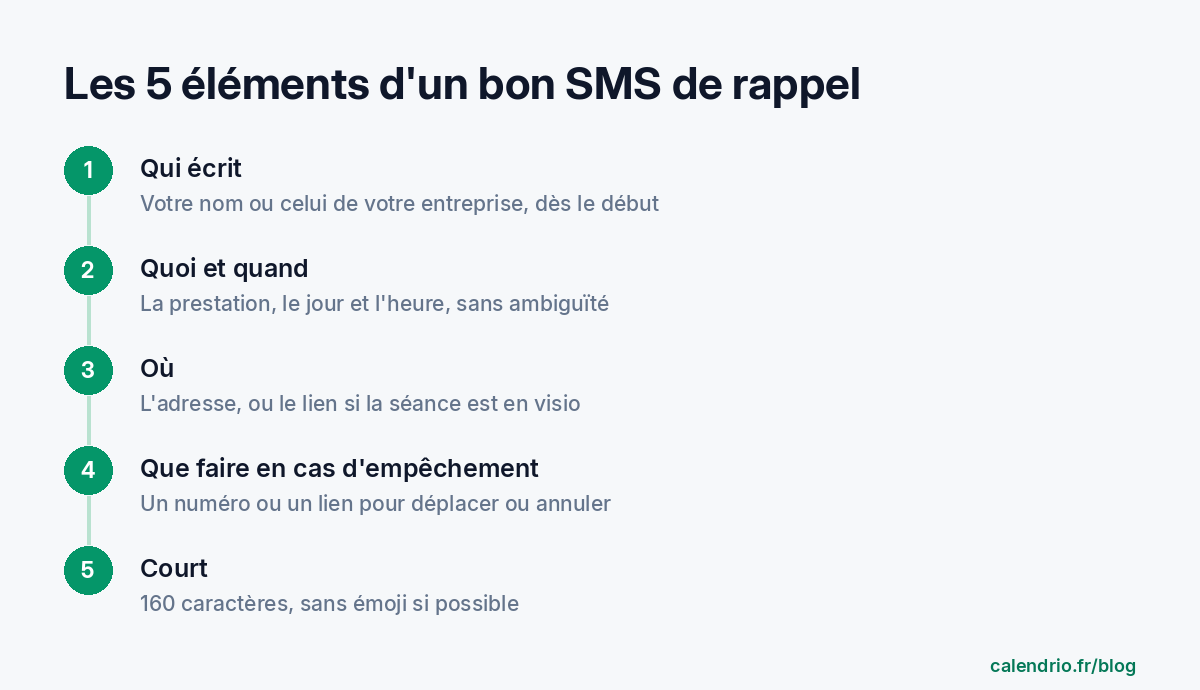
What an appointment reminder SMS should include
A good reminder answers the questions the client asks themselves while reading it, and no others. It includes:
- Who is writing: your first name, the name of the salon or practice. An SMS from an unknown number with no signature is often ignored.
- What and when: the service if useful, the day ("tomorrow, Tuesday") and the time. Writing the day out in full avoids date mix-ups.
- Where: the address if the client is coming for the first time, or the login link for a video session.
- What to do if they can't make it: a number or a link to move the appointment. A client who can cancel easily lets you know more often, and you can offer the time slot to someone else.
And that's it. Promotions, news and tips belong elsewhere: mixed into a reminder, they dilute the useful information and change the nature of the message.
160 characters: why you should write short
A standard SMS is 160 characters at most. Beyond that, the message is split into several parts, and each part is billed as an SMS. The technical documentation of the carrier Twilio points out a lesser-known trap: a single special character, like an emoji or a curly apostrophe, switches the whole message to a different encoding, where the limit drops to 70 characters. Some accented letters have the same effect.
To stay within a single SMS:
- ban emojis, even a small heart;
- use the keyboard's straight apostrophe rather than the curly apostrophe some software inserts automatically;
- write links without "https://" when your tool allows it;
- remove long phrases: "Hi Julie" is enough, no need to add "we hope you're doing well".
Always check your template with a character counter before saving it. Ten characters too many can double the cost of each send.
SMS reminder templates for the day before the appointment
These three templates cover most situations. The first is the most neutral, the second suits a more casual relationship, the third a first appointment.
Standard reminder: "Hi [First name], a quick reminder: appt tomorrow [day] at [time] at [Name]. Something came up? Let us know at [number]. See you tomorrow!"
Casual reminder: "Hi [First name], it's [your first name]. See you tomorrow at [time]! If you can't make it, just tell me here. Have a nice evening."
First appointment: "Hi [First name], appt tomorrow [day] at [time] at [Name], [short address]. Please arrive 5 min early. Something came up: [number]."
In the French versions of these templates, we deliberately write "A demain" without an accent on the capital A, and "imprévu" rather than "empêchement". The capital À and the ê aren't part of the standard SMS alphabet, and a single one of these characters would bring the message down to 70 characters.
SMS reminder templates by profession
Each profession has its useful detail: a duration to plan for, what to wear, a document to bring. Add it: that's what makes the reminder truly practical.
Hairdresser: "Hi [First name], appt tomorrow [time] at [Name] salon for your [cut/color]. Something came up? Call [number]. See you tomorrow!"
Beautician: "Hi [First name], your [treatment name] is booked tomorrow at [time] at [Name]. Please let us know 24 hours ahead if anything comes up: [number]."
Physical therapist: "Hi [First name], session tomorrow [day] at [time] at [Name] practice. Bring your prescription and comfy clothes. Something came up: [number]."
Personal trainer: "Hey [First name], session tomorrow [time] at [place]. Water, towel and sneakers! If you need to move it, reply before tonight. [Your first name]"
Wellness practitioner: "Hi [First name], your [discipline] session is booked tomorrow at [time] at [short address]. Something came up: [number]. Have a lovely evening, [first name]"
Lawyer, consultant: "Hello [First name], a reminder of our appointment tomorrow [day] at [time] at [Name] office. Please bring the requested documents. To reschedule: [number]."
Home tradesperson: "Hello [First name], [Name] will come by tomorrow between [time] and [time] for [job]. Please make sure we can get in. Something came up: [number]."
For the trainer, only keep the very casual tone if that's how you usually talk with this client. For a consulting firm, stay sober: no exclamation mark, no overly warm phrasing.
Confirmation SMS templates right after booking
The day-before reminder works better when the client has already received a confirmation at the time of booking. This first message serves as a record: the client can save it, and they already know how to reach you.
Simple confirmation: "Hi [First name], your appt on [date] at [time] at [Name] is confirmed. To move it: [number or link]. See you soon!"
Confirmation with deposit: "Hi [First name], appt on [date] at [time] confirmed, deposit received. You can cancel up to [notice period] before: [link]. [Name]"
Rescheduled appointment: "Hi [First name], your appt has been moved to [date] at [time]. Thanks for letting us know! [Name]"
If you ask for a deposit, the cancellation notice period must be the same everywhere: on your booking page, in this SMS and in your terms. Our cancellation policy template helps you set it, and the article acompte or arrhes (the two types of deposit under French law) explains what each option means if the client cancels.
What studies say about SMS reminders
SMS reminders have mainly been studied for healthcare appointments. A Cochrane review published in 2013, covering 7 studies and 5,841 participants, puts attendance at 678 per 1,000 appointments without a reminder, versus 773 per 1,000 with an SMS reminder. In the same review, SMS performs on par with a phone call: 795 attendances per 1,000 with an SMS, 803 with a call, across 3 studies.
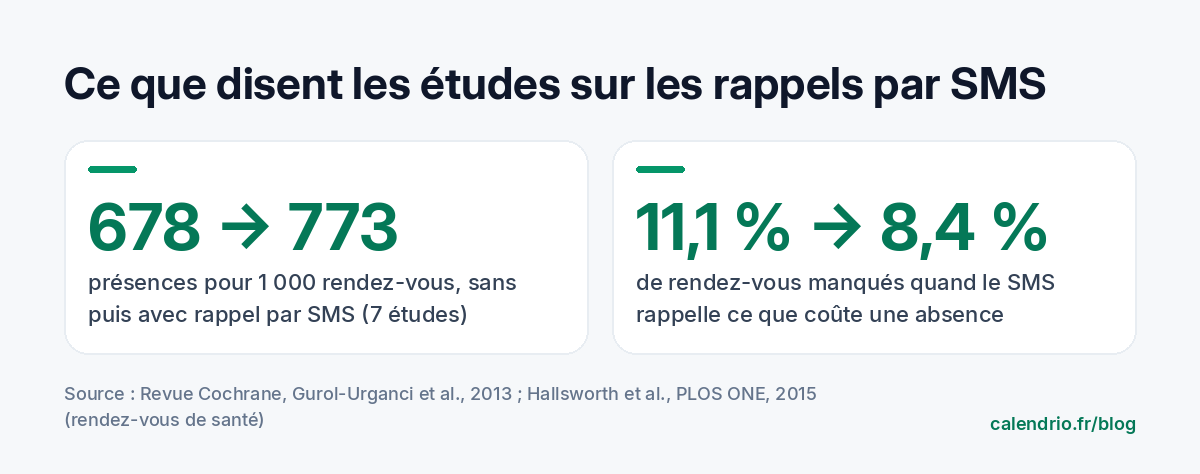
Wording matters too. Two trials carried out in English hospitals and published in PLOS ONE in 2015 (Hallsworth et al.) compared several reminder texts sent five days before the appointment. In the first trial, with 10,111 patients, the message stating what a missed appointment costs brought the no-show rate down from 11.1% with the usual message to 8.4%. In the second, the message with a specific figure did better than the same idea expressed in general terms: 8.2% no-shows versus 9.9%.
These studies concern the English health system: nothing guarantees the same results in a salon or a practice. They do, however, confirm two useful ideas. A reminder is better than no reminder, and a concrete message does better than a vague phrase. For a self-employed professional, the equivalent of the "cost" is often the time set aside: "this one-hour slot is reserved for you".
When to send it, and mistakes to avoid
The evening before is still the most common habit: the appointment is close enough not to be forgotten, and far enough away for the client to let you know. For an appointment booked several weeks in advance, a first confirmation message at booking keeps the day-before reminder from coming as a surprise.
The most frequent mistakes:
- Sending late at night or early in the morning: an SMS received at 10 pm annoys more than it helps.
- Forgetting to sign: the client doesn't know who is writing, especially if you rarely message them.
- Making cancellation difficult: without a number or a link, a client who can't come doesn't let you know, and you lose the time slot.
- Adding a promotion: the reminder becomes a marketing message, with different rules (see below).
- Sending the same text to everyone without rereading it: a reminder "for your cut" received by a client booked for a color makes a bad impression.
If a client forgets anyway, don't penalize them straight away. Our guide to missed appointments presents nine methods to reduce no-shows without putting anyone off.
Appointment reminder or marketing message: the difference to know
An appointment reminder informs a client about a service they booked themselves. A message offering a deal, a discount or a new service, on the other hand, counts as marketing. The CNIL (the French data protection authority) points out that marketing by SMS to private individuals in principle requires their prior consent, except for clients who are offered products or services similar to those they've already bought. In all cases, each message must make it possible to identify who is sending it and to easily refuse further messages.
The practical rule is therefore simple: keep your reminders purely informative, and send your offers in separate messages, with a way to unsubscribe. To bring a client back without being pushy, our article on how to follow up with a client offers suitable templates. For a specific question about your situation, refer to the CNIL's pages or a legal professional.
- A good SMS reminder says who is writing, what, when, where, and how to let you know if the client can't make it.
- Stay under 160 characters: no emojis, no curly apostrophes, no unnecessary phrases.
- Add the detail that's useful for your profession: prescription, clothing, documents, access.
- Send a confirmation at booking, then a reminder the evening before.
- Keep the reminder informative: marketing offers go in separate messages.
How Calendrio helps you remind clients of their appointments
With Calendrio, your clients book online 24/7 and automatically receive an email reminder: the day before on the free plan, and on paid plans as well as during the trial at the time you choose (the day before by default, or 2 days, 2 hours or 1 hour before), with the video link when there is one. Our guide to automatic appointment reminders explains how to set it up, and how your clients can choose their own. Since October 9, 2026, the reminder can also be sent automatically by SMS (paid plans and trial): in Settings, then Business, "Your clients' reminders", choose "Also by SMS" and the timing (2 days, the day before, 2 hours or 1 hour before). This automatic SMS is short and accent-free so that it fits in a single SMS: your business name, the day and time, and a link to cancel online. SMS reminders are included each month (50 on Pro, 200 on Team, 10 during the trial), then €0.10 excl. VAT per SMS, taken from your balance: see our page on automatic SMS reminders. For a more personal message, like the templates above, SMS messages are sent on request from the Calendar & CRM: you select your clients, write your message and see, before sending, the number of characters, the number of SMS per client and the cost.
An SMS costs €0.10 excl. VAT per 160 characters, and €2 of credit is offered when you sign up so you can try it. You can test everything with the one-month free trial, no credit card and no commitment.
Frequently asked questions
When is the best time to send an appointment reminder text?
How many characters can a reminder SMS contain?
Do I need the client's consent to send them an SMS reminder?
What should a reminder SMS include to reduce no-shows?
Can Calendrio send the reminder SMS automatically?
What if your calendar filled itself?
With Calendrio, your clients book online 24/7 and receive automatic reminders. 1-month free trial, no credit card required.
Try Calendrio for free- Cochrane Library — Mobile phone messaging reminders for attendance at healthcare appointments (Gurol-Urganci et al., 2013)
- PLOS ONE — Stating appointment costs in SMS reminders reduces missed hospital appointments (Hallsworth et al., 2015), notice UKHSA
- Twilio — How long can a message be? (limites de caractères d'un SMS)
- CNIL — La prospection commerciale par courrier électronique, SMS-MMS et automate d'appel