B2B email prospecting: the simple method for the self-employed
You want to work with companies, but email prospecting seems risky or technical? Here is what the law says, the method that works for a self-employed professional, the results you can honestly expect, and an email template to adapt.
Yes, B2B email prospecting is allowed in France, and it can bring you clients, as long as you target professionals, talk to them about their work and give them a way to say no in every message. After that, what makes the difference is the method: an address in your own name, reasonable sending volumes, a single follow-up and a simple way to book an appointment.
This guide is for self-employed professionals who also want to work with companies: wellness practitioners who run sessions in the workplace, coaches, consultants, trainers, tradespeople. It explains what the law says, what gets an email delivered and answered, what you can honestly expect, and what a service can do for you.
Is email prospecting legal, and does it really work?
Yes to both, within limits: it's legal towards professionals, under conditions, and it can work on a small scale, with no guaranteed results. The French Ministry of the Economy points out that for a private individual, prior consent is the rule, whereas for a professional it is in principle a right to object: each message must state your identity and offer a free, easy way to unsubscribe.
The CNIL, the French data protection authority, distinguishes two cases. A generic company address (contact@, info@) can receive your message without prior agreement. For a personal address (firstname.lastname@), the person must have been told, when their address was collected, that they could object to its use for marketing, and your message must relate to their job: offering a stress management workshop to an HR manager, yes; selling her a treatment for her weekend, no.
Does it work? Yes, but on a small scale and not overnight. For Calendrio Prospection, we give a cautious order of magnitude: a few replies and 0 to 2 appointments for every 100 companies contacted during the first weeks. This is our estimate, not a statistic or a promise: it all depends on your profession, your targets and your message. That's why the method is most worthwhile when a single new business client brings you far more than prospecting costs you.
The rules to follow in every email
- Professionals only, contacted about their business.
- Your identity as the sender, clearly stated.
- A simple way to stop receiving your messages (a link or "reply STOP"), applied immediately and for good.
- No invisible pixel that tracks whether your emails are opened without the recipient's consent: as a general rule, this is what the CNIL asks in its recommendations of 14 April 2026.
These rules summarise the official sources listed at the bottom of the page. For a specific case, ask a legal advisor.
An example: a sophrologist who wants to work with companies
Here is a made-up example, based on a common situation. A sophrologist with her own practice has recently started offering 1.5-hour workshops on stress management, for groups of 8 to 12 employees, on site or by video call. On the company side, this kind of workshop often comes under quality of working life: depending on the case, she contacts management, human resources or the staff committee (CSE). A single company that orders a series of workshops can bring her as much as a month of individual sessions. So she has every reason to prospect companies, but she has neither the time nor the wish to become an expert in sending emails.
| Before: she manages on her own | After: a clear method | |
|---|---|---|
| Sending address | Her personal Gmail address | An address on her own domain name, for example firstname@her-practice.fr |
| Recipients | 200 addresses copied in one evening, unsorted | 100 companies in her region, chosen by size, with the contact address the company publishes itself |
| Message | A long text about sophrology, the same for everyone | A short email about the company's business, with a single question and a link to book a call |
| Sending | Everything goes out the same evening | A few emails a day, on weekdays, then a single follow-up |
| Replies | Mixed in with her personal emails, some forgotten | Every reply followed up, appointments straight in her calendar |
The second column takes a little preparation, but each row reduces the risk of ending up in the spam folder.
B2B email prospecting: what gets an email delivered, then answered
An address in your own name, never a free email service
An email sent from a Gmail or Hotmail address to dozens of companies doesn't inspire much trust, and email providers are wary of this kind of sending. You need a domain name (for example your-practice.fr) and an address on it. You don't need a website for that. Your technical settings matter too: Google asks all senders who write to personal Gmail accounts (@gmail.com addresses) to authenticate their emails (settings called SPF or DKIM) and to keep their spam complaint rate below 0.3%, even recommending staying below 0.1%. These rules apply to Gmail, but they are good benchmarks for all email providers. These settings are done once and for all, but they must be correct.
Reasonable, gradual sending
A new address that suddenly sends hundreds of emails looks like a robot. It's better to start slowly, spread your emails over the day, on weekdays, then increase little by little. Reasonable sending looks like a real exchange and lands in the inbox more often.
A short email that talks about the other person
The person who receives your email asks themselves just one question: "what's in it for me?". A good first email is a few sentences long, mentions a detail about their company, explains in one sentence what you bring and asks a single question. Add your booking link: an interested person picks a time slot themselves, with no back-and-forth emails to find a date.
Example of a first email, to adapt
Subject: Stress workshops for your teams in [town]
"Hello [first name], I'm a sophrologist in [town] and I run 1.5-hour workshops on stress management, for groups of 8 to 12 people, at your premises or by video call. Busy periods such as [the end of the year, closing the accounts, the season] are often when this kind of workshop is most in demand. Is this a topic at [company] right now? If so, you can book a 15-minute call here: [link]. Have a good day, [first name last name], [business], [address]. To stop receiving my messages, reply STOP."
Example of a follow-up, a few days later
Subject: Re: Stress workshops for your teams in [town]
"Hello, I'm bringing my message from last week back to the top of your inbox. If the topic isn't relevant to you, a simple 'no thanks' is enough. Have a good day, [first name last name]. To stop receiving my messages, reply STOP."
A single follow-up, then stop
A short follow-up gives a second chance to an email that went unnoticed: two or three sentences, no pressure, a few days later. Beyond that, insisting becomes annoying. And as soon as someone replies, even to say no, you don't follow up with them again.
How much it can bring in: do the right calculation before you start
Start from what a business client brings you, not from the number of emails sent. In our example, let's take a series of four workshops invoiced at €1,200 (an illustrative figure). A single signed client then pays for the pilot (€290 excl. VAT) and more than six months of the service afterwards (€149 excl. VAT per month with the "Calendrio Pro + Prospection" subscription). On the other hand, if you target small shops for a €40 service, you'll need a lot of clients for the effort to pay off: other channels, such as local partnerships or your Google listing, will often be more effective.
Also bear in mind that the first weeks are for learning: which companies reply, which email subject works, which question leads to a call. A weekly review lets you adjust your message.
Do it yourself or get help?
You can do everything yourself: buy a domain name, create the address, set up the settings, build your list, write and send each email, note the replies in a spreadsheet. It costs no money, but it takes time and some technical knowledge, and a wrong setting can send your emails to spam without you knowing.
It's to spare you this technical part that we created Calendrio Prospection, a service that does it for you:
- Your professional address: you connect it in one minute, all the settings are checked automatically, and if something is missing, the page gives you the exact line to copy.
- Your targets: you tell us who to contact, we find the companies that match. You review, remove or add your contacts.
- Your message: we write your email and a follow-up suited to your profession. You edit them yourself and you see the exact email that will go out.
- The launch: the emails go out from your address, gradually, every working day. Nothing goes out before you have approved the list and the texts.
- The follow-up: every reply is passed on to you, often with a suggested answer to send in one click, and appointments arrive in your Calendrio calendar. A review is sent to you every Monday.
Your domain name and your email address stay in your name: if you stop, you keep them, along with your contact list and the history of your campaigns.
What the service doesn't do
- It never contacts private individuals: it's reserved for prospecting professionals (companies, shops, practices, agencies).
- It promises no number of appointments: we give you the usual orders of magnitude, not a guaranteed result.
- It doesn't make calls or prospect on social media: it handles emails.
- It doesn't send anonymous emails: each message ends with your signature, the unsubscribe line and a short mention added to each email, "Appointments managed with Calendrio".
- It requires a domain name: if you don't have one, we guide you to buy one in your name.
The price, with no surprises
The pilot lasts 4 weeks and costs €290 excl. VAT, all included: setting up your address, a list of 100 companies, texts, sending, follow-up and tracking. It's paid online when you make the request. If the pilot can't go ahead, you're refunded in full.
- Afterwards, the service continues on its own, with 100 new companies contacted every month. This is stated before payment, and the rest is paid with the card used for the pilot.
- Its price: if you have a paid monthly Calendrio subscription, €110 excl. VAT per month is added to it. Otherwise, you switch to the "Calendrio Pro + Prospection" subscription at €149 excl. VAT per month.
- No commitment: you stop it whenever you want from Settings → Subscription & Billing. Cancellation takes effect at the end of the current period.
- Appointment guarantee: if no appointment is obtained within 60 days of your emails starting to go out, your 2nd month is free, automatically. For this, the service must have continued after the pilot (terms of sale, article P11).
The details are on the Pricing page.
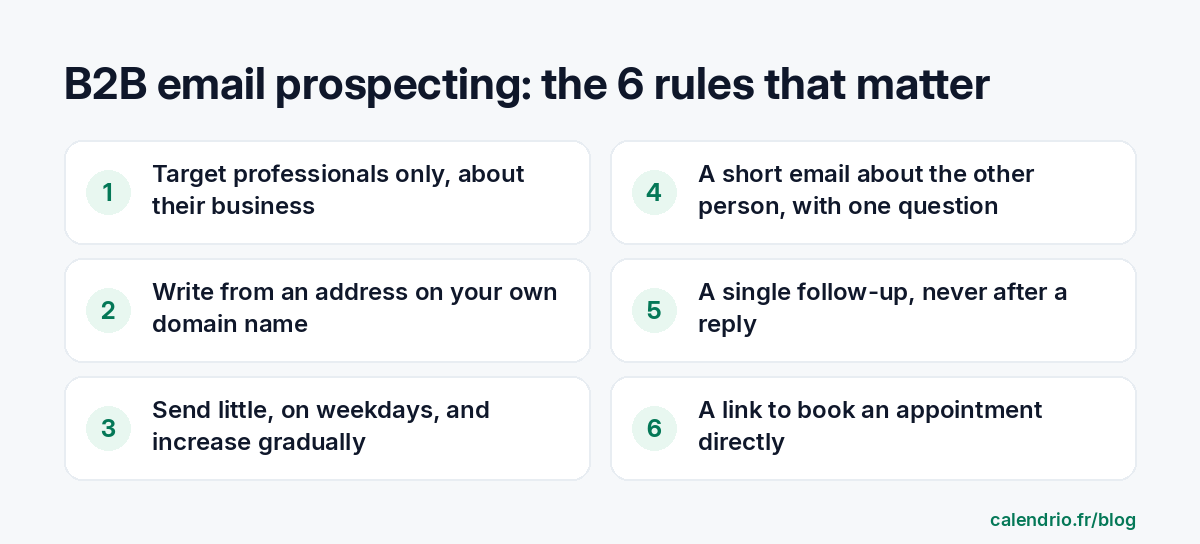
- Towards professionals, email prospecting is in principle allowed without prior agreement if the message relates to their job, states your identity and offers a way to unsubscribe; for a personal address, the person must have been told about their right to object.
- Write from an address on your own domain name, never from a free email service.
- Send little and gradually, a short email with a single question, then a single follow-up.
- Our cautious estimate: a few replies and 0 to 2 appointments for every 100 companies in the first weeks. The method is worth it when one client brings in a lot.
- Add a booking link: an interested person picks their own time slot.
Launch your first campaign
If you offer services to companies, like wellness practitioners who run workshops, and you'd rather spend your time on your clients than on settings, you can request your pilot in two minutes. You review your targets and approve your texts before anything is sent. Discover Calendrio Prospection.
Frequently asked questions
Is email prospecting legal, and does it really work?
Can you use a Gmail address for prospecting?
How many prospecting emails should you send per day?
How many times should you follow up with a company that doesn't reply?
Do you need a website to prospect by email?
What if your calendar filled itself?
With Calendrio, your clients book online 24/7 and receive automatic reminders. 1-month free trial, no credit card required.
Try Calendrio for free- Ministère de l'Économie (Bercy Infos Entreprises) — Courriels et newsletters : quelles obligations ? (mis en ligne le 08/09/2026, consulté le 19/10/2026)
- CNIL — Les règles d'or de la prospection par courrier électronique (consulté le 19/10/2026)
- CNIL — Pixels de suivi dans les courriels : la CNIL publie ses recommandations (14/04/2026, consulté le 19/10/2026)
- Google — Consignes pour les expéditeurs de messages, aide Gmail (consulté le 19/10/2026)