Finding clients when you're starting out: 9 practical actions for the self-employed
Your business is registered, your equipment is ready, but the clients are missing. Here are nine practical actions, from the quickest to the most lasting, to fill your calendar during the first months, with examples by profession and messages ready to copy.

You have your business status, your equipment, maybe a space of your own. What's missing is the essential part: clients. Finding clients when you're starting out is a self-employed professional's first real test, and it isn't solved with a nice logo or a single social media post. It's solved with a clear offer, a few well-chosen channels and a routine kept up every week.
This guide brings together nine practical actions, ranked from the quickest to the most lasting, with examples by profession and messages ready to copy. It's mainly for professionals who work by appointment: hairdressers, beauticians, physical therapists, coaches, wellness practitioners, tradespeople, lawyers.
Why your first clients are crucial
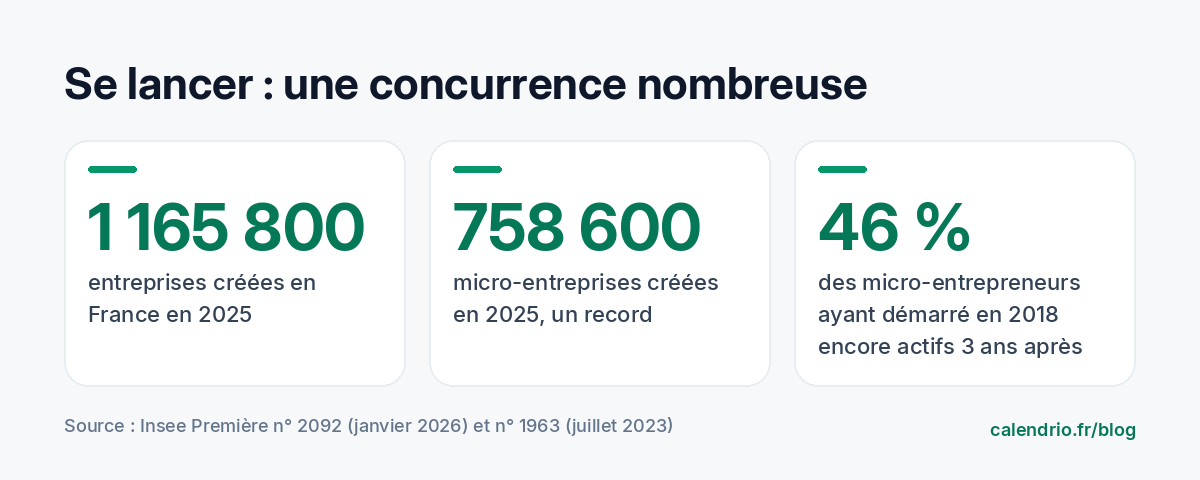
Competition from newcomers is strong. According to Insee (the French national statistics institute), 1,165,800 businesses were created in France in 2025, including 758,600 micro-enterprises (the simplified French self-employed status), their highest level ever. In your town, other professionals are starting out at the same time as you.
Staying in business takes time. Insee followed micro-entrepreneurs registered in the first half of 2018: three years later, 46% of those who had started their business were still active. Another Insee study, published in 2026, shows that for those whose business continued for five years, average revenue rose by 27% between 2019 and 2023. In other words, a client base is built over time: the first months are for laying the foundations.
1. Define who you want to serve, and for what
"Everyone" isn't a target. One clear sentence will save you months: I help [who] to [get what] through [which service]. A beautician might write "facials for sensitive skin, at home"; a personal trainer, "getting young parents back in shape, 45-minute sessions near you".
This sentence works everywhere: on your Google listing, your booking page, your Instagram bio, your business card. It also helps word of mouth: the people close to you know exactly who to recommend you to.
2. Announce your launch to the people around you
Your first clients are often only one or two contacts away. Make a list of 30 to 50 people: family, friends, former colleagues, neighbors, members of your club. Send them a personal message, not an ad.
Launch message template to copy
"Hi [first name], I have some news to share: I've just set up as a [profession] in [town]. I offer [main service]. If you know anyone it could help, you can pass on my booking link: [your link]. Thank you so much, it means a lot when you're just starting out!"
Explicitly ask for a recommendation rather than an appointment: it's easier to say yes to, and it opens up a second circle.
3 to 5. Be easy to find and easy to book
These three actions form the foundation: they work for you even when you're with a client.
3. Create and complete your Google listing
When someone searches for "physical therapist near me" or "hairdresser [neighborhood]", Google first shows business listings. A complete listing, with opening hours, photos, exact categories and a booking link, is one of the most cost-effective channels for a local professional. Our guide to optimizing your Google Business Profile goes through each field.
4. Put your booking link everywhere
An interested client must be able to book in under a minute, without calling you. Place your online booking link (our article on where to share your booking link details nine places to put it):
- on your Google listing, in the "appointments" field;
- in your social media bios;
- in your email signature and your voicemail message;
- on a QR code in your window, on your business card and your flyers.
Every step you remove (a call, a message to wait for) increases the chances that the person will see it through.
5. Ask for a review after every first appointment
When you're starting out, a listing with no reviews inspires little confidence. Get into the habit of asking every new satisfied client for a review, the same day, with the direct link. The first reviews are the hardest to get and the ones that matter most. Our method to get Google reviews gives you message templates.
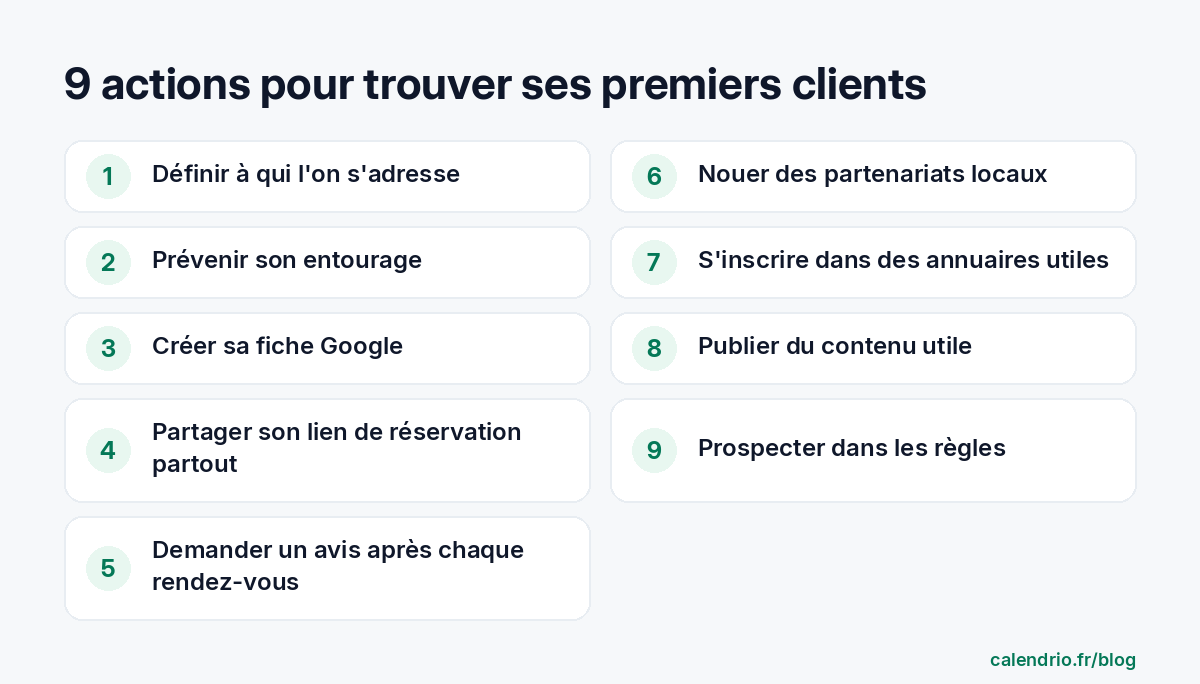
6. Build partnerships with nearby professionals
The best referrers are professionals who see your future clients before you do, without being your competitors. A few examples:
| Your profession | Possible partners | Exchange idea |
|---|---|---|
| Hairdresser | Beautician, wedding photographer | Each other's cards in the salon, a joint "bride" offer |
| Physical therapist | Personal trainer, gym | Referring people to each other based on their needs |
| Personal trainer | Dietitian, sporting goods store | A joint free workshop, flyers in the store |
| Wellness practitioner | Midwife, yoga center | An intro session during a workshop |
| Tradesperson | Real estate agency, property manager, hardware store | A card left for new homeowners |
For regulated professions (health, law), check with your professional order or organization what's allowed in terms of communication and partnerships before committing.
Template for reaching out to a partner
"Hello, I'm a [profession] who recently set up at [address]. Our clients are similar without us being competitors. Would you be open to a 20-minute coffee next week? I'd like to introduce my business and understand yours, so I can send people who need you your way."
7. Sign up to useful directories
Specialized and local directories are still a way in: your federation's or professional order's directory, your town hall's or local business association's website, appointment booking directories. Favor those that lead directly to booking, and check that your details there are identical to those on your Google listing: same name, same address, same phone number.
8. Publish content that answers your clients' questions
There's no need to post every day. One useful post a week is better than five empty ones. Answer the questions people ask you during appointments: "how long does a color last?", "what should I do before a physical therapy session?", "do I need a quote to replace a water heater?". These answers show your expertise and give people a reason to follow you. End each post with your booking link.
9. Prospect directly, while following the rules
If you also work for businesses (a coach offering sessions in companies, a tradesperson targeting property managers, a lawyer advising shopkeepers), direct prospecting has its place. The CNIL (the French data protection authority) points out that sending marketing messages by email to private individuals in principle requires their prior consent. For professionals, it isn't required if the person is informed that they can object to the messages free of charge and if the message relates to their profession. If in doubt, check the CNIL's rules or consult a legal advisor.
In practice: write little, to carefully chosen people, with a personalized message and an unsubscribe link. Ten relevant messages are better than five hundred generic ones.
What routine to keep during the first three months
Consistency matters more than intensity. Reserve a fixed block in your calendar, twice a week, devoted only to finding clients. Example breakdown:
- Week 1: positioning sentence, Google listing, booking link placed everywhere, messages to the people around you.
- Weeks 2 to 4: systematic review requests, three meetings with partners, signing up to two directories.
- Months 2 and 3: one useful post a week, following up with partners, targeted prospecting if you're aiming at businesses.
Once your first clients have arrived, don't lose them: our ideas for building client loyalty will help you turn a first appointment into a habit.
- Start with a clear sentence: who you're for and what you bring.
- The people around you and nearby professionals are your first referrers: ask for recommendations.
- A complete Google listing, your booking link everywhere and reviews from your very first clients form the foundation.
- Post little but useful content, and prospect businesses while following the CNIL's rules.
- Block two fixed time slots a week for finding clients, for at least three months.
How Calendrio helps you turn interest into appointments
Calendrio gives you a booking page in your name, with a QR code, that your future clients use 24/7 to book on their own. Your profile can also appear in the public "Find a pro" directory, with a "Near me" button for people looking for a professional close to home. After each appointment, a Google review request goes out automatically.
To get started at no cost, the Free plan lets you offer two services, with online payment and syncing with your Google or Outlook calendar; the one-month free trial of the full plan requires no credit card and no commitment. The details are on the Pricing page.
Frequently asked questions
How do you find your first clients when you're starting out?
Can I send prospecting emails to private individuals?
How long does it take to find clients?
Should I make a launch offer to attract clients?
What if your calendar filled itself?
With Calendrio, your clients book online 24/7 and receive automatic reminders. 1-month free trial, no credit card required.
Try Calendrio for free- Insee Première n° 2092 — Les créations d'entreprises en 2025 (janvier 2026)
- Insee Première n° 1963 — Micro-entrepreneurs immatriculés en 2018 (juillet 2023)
- Insee Première n° 2118 — Micro-entrepreneurs immatriculés en 2018 (juillet 2026)
- CNIL — Les règles d'or de la prospection par courrier électronique