Qualifying your prospects: spotting the businesses that need you
You reach out to businesses, but you're writing somewhat at random? Here's how to spot, using public pages, the ones that genuinely need what you sell, score them simply, and send them a first message that speaks to their situation.
Sending the same email to fifty businesses picked at random wears everyone out, you included. For a freelancer, qualifying your prospects means sorting before you write: spotting, on public pages, the businesses that show a concrete sign they need what you sell, and starting with them. You write less, but to people who have a reason to read you.
This guide gives you the method: choose your signs of need, check them in a few minutes, score each business from 0 to 4, write a first message about what you noticed, and know the limits of the exercise, including what the law requires.
Qualifying prospects before the first email: what are we talking about?
Sales guides often talk about qualification during the call: budget, decision-maker, timeline. That's useful for a sales team. A freelancer, though, doesn't have time to call everyone. The sorting has to happen before the first contact, using what's visible from the outside.
That's where signs of need come in: public clues suggesting that a business has, right now, the problem you know how to solve. A business that has just opened, that is hiring, that has no online booking even though its clients make appointments. None of these signs proves a need. Together, they tell you where to start.
Finding your signs of need based on what you sell
Start from your offer, not from the target. Ask yourself: in what situation did a client need me, and what, from the outside, gave that situation away? Keep three or four signs, no more. Beyond that, you spend more time checking than writing.
A good sign meets three conditions: it's public, it can be checked in a few minutes, and it's directly linked to what you offer. “Great, dynamic company” is not a sign. “Posted three job openings this month” is one.
| You are… | You're targeting… | Possible signs of need |
|---|---|---|
| A provider selling to practitioners (website, photos, booking tool) | Wellness practitioners | No online booking, only a phone number; recently set up; visibly full schedule (“fully booked”, waiting list); no website |
| Accountant | Restaurants | Recently opened; change of owner; currently hiring |
| Sophrologist running workshops | Small businesses | Currently hiring; new premises or recent move; careers page that mentions team well-being |
| Photographer | Beauty salons | Recently opened; website or listing with no photos of the premises; new treatment menu announced |
| Web designer | Tradespeople | No website; website unreadable on a phone; Google listing with no link to a website |
Take the first row. A practitioner who sees clients by appointment, with no online booking, handles everything by phone, often between two sessions. If they've just set up, they're building their organization now. If they're fully booked, every missed call may be a lost client. These are three situations where a booking solution has a real reason to be of interest.
A concrete case: a sophrologist targeting businesses
Here's a made-up example, based on a common situation. A sophrologist with her own practice offers 1.5-hour workshops on stress management for groups of employees, on site or by video call. She wants to write to small businesses in her city. She picks four signs:
- the business is currently hiring (job openings on its website or careers page);
- it has recently opened new premises or moved;
- it talks about the well-being or quality of life of its teams on its website;
- it already organizes group events (seminar, team day) visible on its social media.
On her list, a reception and call-answering agency scores 3 out of 4: it's hiring, it has opened a second site, and its careers page talks about work-life balance. An architecture firm scores 0: nothing visible links its current activity to a group workshop. The sophrologist writes to the agency first. The firm simply comes later.
Where to check each sign without spending all evening on it
A few free sources are enough for most signs:
- The Annuaire des Entreprises (annuaire-entreprises.data.gouv.fr), the French government's free public business directory: the company's creation date, activity and address. It's the simplest way to spot a recent opening.
- The business's website: whether it has online booking, a careers page, news, and how well it displays on a phone.
- Its Google listing: opening hours, photos, recent reviews, link to a website or booking page.
- Its social media: opening announcements, “fully booked this week”, team events.
Set yourself a time rule, for example five minutes per business. If a sign can't be checked within that time, count it as absent and move on to the next one.
Scoring your prospects from 0 to 4 and deciding where to start
The method fits in one line: one point per sign observed. A business that shows all four of your signs scores 4, a business that shows none scores 0.
Next to the score, write the reason in one sentence: “Opened recently, phone bookings only.” This sentence will serve you twice. It reminds you why you're writing, and it becomes the hook of your first message.
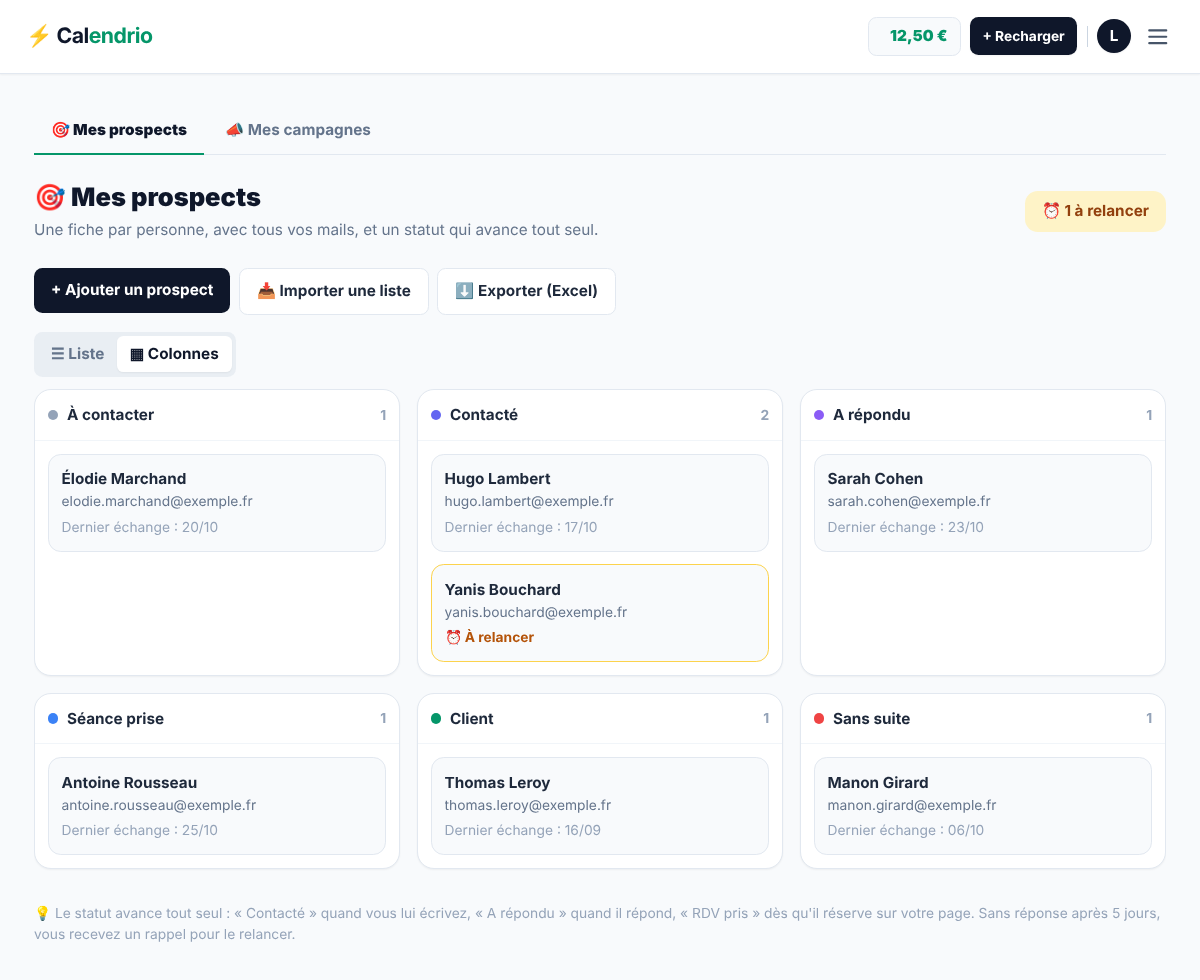
Then sort the list from the highest score to the lowest. Write first to the best-scored businesses. Set aside those at 0: you can still keep them if you know them from elsewhere, it's your call. Record the score and the reason in your tracking tool, for example in the notes on the record, a spreadsheet or a prospect list, so you can find the history of each contact.
Writing a first message that mentions the sign, without seeming intrusive
A well-chosen sign makes your email personal with no effort. You still need to mention it tactfully. A few rules:
- only mention a public, professional fact, never a detail about the person's life;
- say where you saw it (“on your website”, “on your listing”);
- describe, don't judge: “I couldn't find online booking” rather than “your website is outdated”;
- one sign per message, followed by a single question.
First message template to adapt
Subject: A workshop for your new teams?
Hello,
I saw on your website that you're hiring several people for your new site in [city].
I'm a sophrologist in [city] and I run 1.5-hour workshops on stress management at work, for groups of employees, at your premises or by video call.
Welcoming several new people at once takes energy from the whole team. A workshop can be a simple moment to step back together.
Would you like me to send you the programme?
Kind regards,
[First name Last name], sophrologist
[booking link]
To stop receiving messages from me, simply reply STOP.
For what comes next (sending address, pace, follow-ups), see our guide to B2B email prospecting.
What a sign doesn't tell you, and what the law requires
A sign of need is a clue, not a certainty. A business with no online booking may have chosen the phone, and be doing just fine. A high score tells you where to start, not who will say yes. Keep an open tone and accept a no without insisting.
As for the rules, the CNIL (the French data protection authority) points out that for email prospecting between professionals, the recipient's prior consent is not required when the address is generic (info@, contact@…) or when the professional was informed, at the time they gave their address, that they could object free of charge to its commercial use. In all cases, the message must relate to their professional activity. Each email must also state on whose behalf it is sent and always offer a way to unsubscribe. A request to stop must be applied without delay, and the data deleted as quickly as possible, keeping only what's needed to make sure you don't write to that person again.
When the business is a single person, such as a practitioner working as a sole trader, the notes you take about them concern them directly. Keep them factual, limited to what serves your approach, and, if they ask you not to contact them again, remove them from your lists, keeping only what's needed to make sure you don't write to them again. For a specific case, ask a legal professional for advice.
- For a freelancer, qualifying prospects means sorting before writing, based on public signs.
- Choose three or four signs linked to your offer, checkable in a few minutes.
- One point per sign observed, one sentence of reasoning, then start with the best-scored.
- Mention a single sign in your first message, tactfully, followed by a single question.
- A sign is still only a clue. A business address, a subject related to their work, a clear identity and an unsubscribe option remain the rule.
What Calendrio Prospection does for you
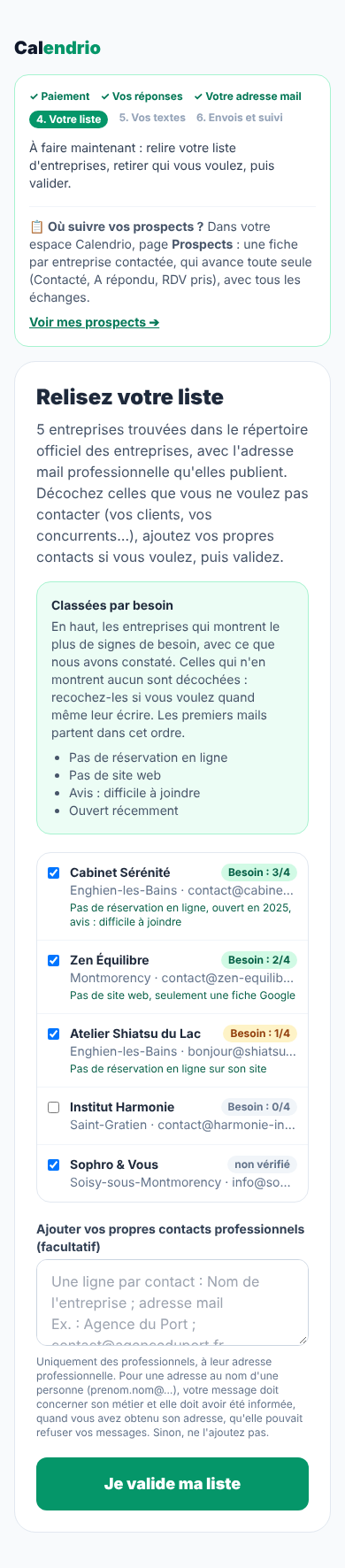
With Calendrio Prospection, we find your targets in the Sirene register, along with their published generic email address, and you review the list before the first emails go out. After the pilot, each month's new businesses are sorted the same way and added without a new review. New: the need score. Based on what you sell and your target, the AI suggests three or four signs of need, which you see on your tracking page while the list is being prepared and which you can edit. While looking up each business's address, it checks these signs on its public pages. Each target gets a score from 0 to 4 (one point per sign observed), with the reason in one sentence, or the label “not checked” when the signs couldn't be verified. On the review page, the list is sorted from the highest score to the lowest. Targets at 0 are unticked by default, and you can tick them again: you have the final say. The first emails go out first to the contacts you added, then in score order, from your business address.
What the service doesn't do: it guarantees neither that a business really needs you, nor a number of replies. For the businesses it finds, it only uses generic addresses (contact@, info@…), never an address in a person's name. The contacts you add yourself remain your responsibility. STOP requests are respected, and, among the businesses found by Calendrio, two professionals in the same trade don't write to the same business within 30 days. If you work with businesses, like wellness practitioners who run workshops, and you're just starting out, begin with the signs that are easiest to check. To manage the appointments that come out of it, you can create your Calendrio account.
Frequently asked questions
What is a qualified prospect for a freelancer?
How many signs of need should you pick?
Is email prospecting legal, and does it really work?
Should you drop businesses that show no signs at all?
Can you mention the sign you noticed in your email without being intrusive?
What if your calendar filled itself?
With Calendrio, your clients book online 24/7 and receive automatic reminders. 1-month free trial, no credit card required.
Try Calendrio for free