Beautician schedule: how to organize your salon calendar in 6 steps
Treatments that run over, waxing squeezed in between, evenings that drag on: for a beautician, the schedule drives both revenue and fatigue. Here's a simple method to build a beauty salon calendar that is profitable and livable.

A facial that runs over, waxing squeezed in "between two", a client calling while your hands are in the wax… For a self-employed beautician, the schedule decides everything: the day's revenue, but also your back and your energy in the evening. A good beautician schedule, in a salon or as a mobile beautician, isn't a calendar filled to the brim. It's a calendar where every treatment has its real duration, where tasks alternate and where the most popular time slots are reserved for the right services.
This guide gives you a six-step method, with a table of durations to block, a sample day and messages ready to copy. It's for beauticians working alone as well as small salons.
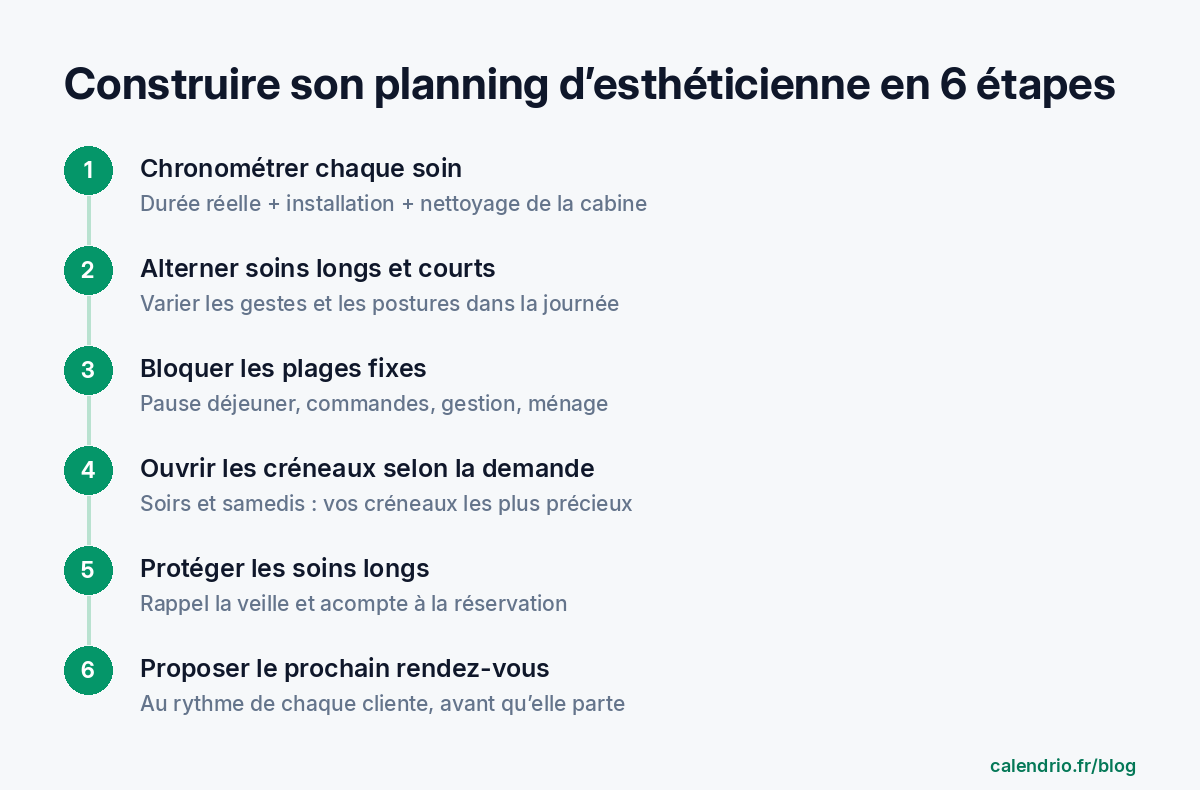
Why a beautician's schedule is a puzzle of its own
Few professions mix so many different durations in a single day. Brow shaping takes a few minutes, a full facial takes much longer, a nail set sits somewhere in between. On top of that come preparing the treatment room, cleaning equipment and time spent at the front desk taking payment or giving advice.
Meanwhile, your body takes the strain. According to the Assurance Maladie (French national health insurance), awkward postures, repetitive movements and long periods standing expose salon professionals to pain in the back, neck, hands, wrists and shoulders. It also lists irregular hours and interrupted tasks among the causes of stress and fatigue. A well-built schedule doesn't remove these risks, but it can avoid making them worse.
Step 1: time your real treatments, not the ones on the menu
The first scheduling mistake is to block the "advertised" duration of a treatment. Yet between welcoming the client, undressing, the treatment itself, getting dressed, payment and resetting the room, the real time is almost always longer. For two weeks, write down each client's arrival and departure time, then the time needed to reset the room. You'll get your durations to block.
Here's what the result might look like. The durations below are a fictional example: replace them with your own measurements.
| Treatment | Advertised duration | Duration to block (example) | Type |
|---|---|---|---|
| Brow shaping | 15 min | 20 min | Short |
| Half-leg wax | 20 min | 30 min | Short |
| Manicure with gel polish | 45 min | 1 hr | Medium |
| Full facial | 1 hr 15 min | 1 hr 30 min | Long |
| Body massage | 1 hr | 1 hr 15 min | Long |
That small gap of five to fifteen minutes, multiplied by around ten appointments, explains most days that end late. Once you know your durations, enter them as they are in your calendar: that's what makes the time slots offered to your clients realistic.
Step 2: alternate long and short treatments
Doing three facials in a row means staying bent over in the same position for a long time. Doing ten waxes in a row means repeating the same wrist movement. Alternating spreads the effort: one long treatment, then one or two short ones, then a seated service like a manicure.
In practice, divide your day into blocks:
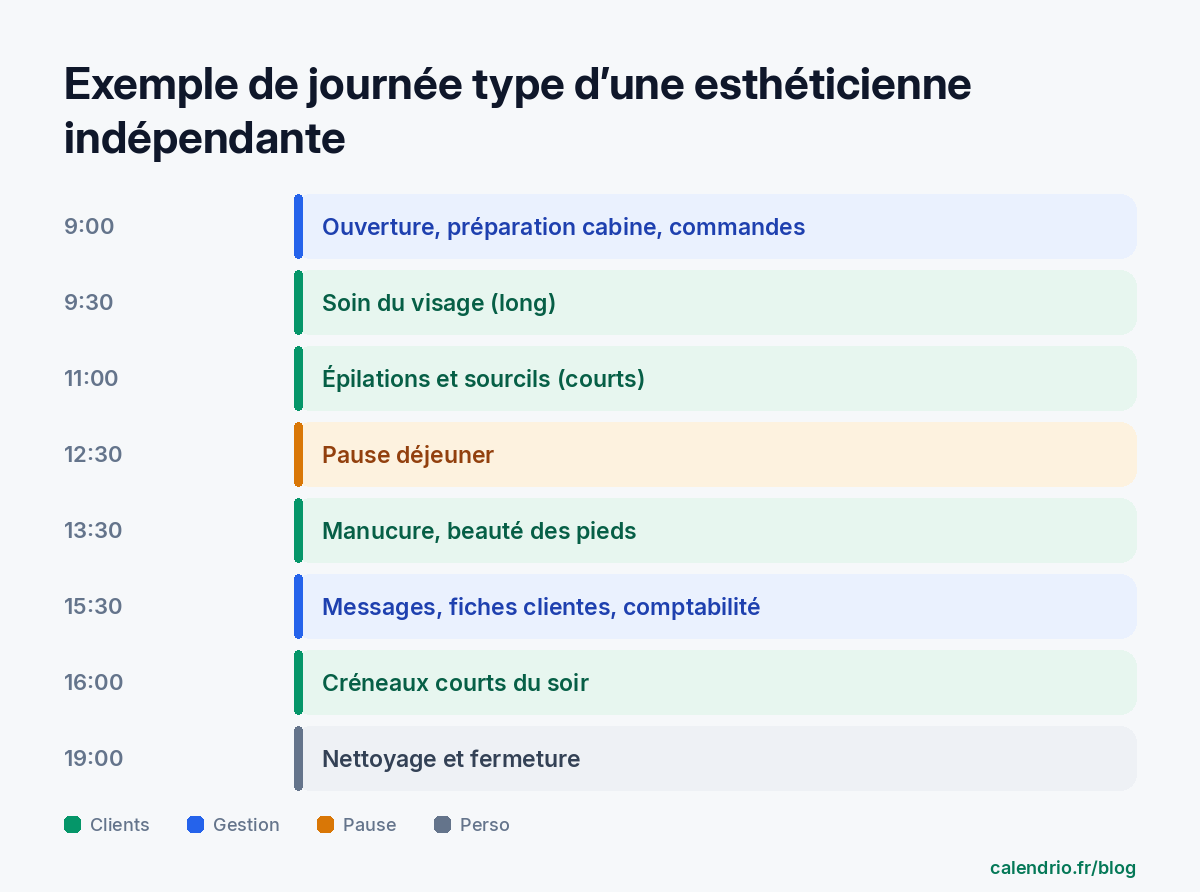
- Morning: long treatments, when you're at your freshest and most precise.
- Midday: seated services (nails, hand and foot care).
- End of the day: short treatments, very popular with clients coming straight from work.
A practitioner working alone as a mobile beautician can follow the same logic, grouping long treatments on days when her trips are short.
Step 3: block fixed time slots before appointments
If you don't set aside time for admin, clients will take it. Before opening a single time slot, put these in your calendar:
- a real lunch break, always at the same time;
- an "admin" time slot for orders, bookkeeping and messages;
- opening and closing time (preparing the room, laundry, cleaning);
- your time off and exceptional closures, as soon as you know them.
That's the principle of time blocking: each type of task has its place, and what isn't planned no longer eats into everything else.
Step 4: save your most popular time slots for the right services
In many salons, late afternoons, Saturdays and the weeks before the holidays go first. Look at your own history: which days and times fill up effortlessly? Those are your most valuable time slots.
Two simple settings help you make better use of them:
- Offer long treatments mainly on weekdays, during the day, to keep evenings for short treatments that fit in more clients.
- Give certain treatments their own hours: for example, the full facial bookable only Tuesday to Friday before 4 pm.
Before busy periods (the end-of-year holidays, weddings, summer vacation), open your schedule earlier and let your regular clients know first.
Step 5: protect long treatments from no-shows
A no-show on brow shaping costs a few minutes. A no-show on a 90-minute treatment empties a whole morning. Long treatments therefore deserve special protection:
- a reminder the day before, with the time and address;
- a partial payment when booking for long or expensive treatments (see our guide acompte or arrhes to choose the right term);
- clear cancellation terms, shown before booking.
To go further, our article on missed appointments details nine methods to combine.
Terms template to display (to adapt):
"For treatments longer than one hour, a partial payment is requested when booking and deducted from the price of the treatment. Please let us know at least 24 hours in advance if you can't make it: your time slot can then be offered to another client."
Step 6: offer the next appointment before the client leaves
Waxing, nails and brows come back at a fairly regular rhythm, specific to each client. That's great news for your schedule: you can fill your coming weeks without prospecting. The ideal moment to bring it up is at the end of the treatment, when the client is happy and has her calendar in hand.
What to say at the front desk:
"To keep a clean result, I'd recommend coming back in about four weeks. Shall I book you the same time slot, Thursday at 6 pm?"
Message for a client who hasn't rebooked (to send to a client who has agreed to receive your messages):
"Hi Julie, it's been a while since we last saw each other! Your usual late-Thursday time slot is free next week. You can book it directly here: [link]. Have a lovely day, [first name]."
In each client's record, note her rhythm and preferences (wax type, products tolerated, sensitivities mentioned). Your schedule becomes more predictable, and the client feels recognized.
Salon or mobile: display rules not to forget
A clear schedule starts with a clear offer. According to Bpifrance Création's guide to beauty salons in France, a salon must display a price list outside with at least 10 prices incl. VAT for its most common services, and inside, where payment is taken, the list of prices incl. VAT for all services. A receipt must be given to the client for services from €25. The same guide points out that the activity is regulated in France: you need a qualification in the field (CAP, BP, bac pro, BTS or brevet de maîtrise), three years of professional experience, or to work under the effective and permanent supervision of a qualified person.
Your situation may have its own specifics: if in doubt, check with your chambre de métiers et de l'artisanat (the French chamber of trades and crafts). For online booking, the logic is the same: each treatment shown with its price and duration, so the client knows what to expect before choosing her time slot.
As a mobile beautician, add one constraint: travel. Group appointments by area, count the driving time between two clients and clearly state your service area and any travel fees.
- Block the real duration of each treatment, including setup and cleaning, measured over two weeks.
- Alternate long treatments, short treatments and seated services to spread the effort.
- Place your break, admin and closures first, then appointments.
- Keep your most popular time slots for the treatments that need them.
- Protect long treatments: a reminder the day before, partial payment, clear terms.
- Offer the next appointment before each client leaves.
How Calendrio helps beauticians stick to their schedule
In Calendrio, each treatment has its own duration, its price and, if you wish, its own hours: your clients only see free time slots online that are long enough for the chosen treatment, 24/7. A reminder goes out automatically by email 24 hours before the appointment (paid plans and trial), a deposit can be requested when booking, and your Google or Outlook calendars are taken into account to avoid double bookings. When a regular client hasn't rebooked, Calendrio can offer her usual time slot by email if it's free; if a time slot opens up, the waiting list is notified. It's all presented on our appointment software for beauticians page.
You can test these settings on your own treatments with the one-month free trial, no credit card and no commitment.
Frequently asked questions
How much time should I leave between two clients in a beauty salon?
Should long treatments be in the morning or the afternoon?
How can I prevent a client from missing a long treatment?
Which prices must a beautician display?
What if your calendar filled itself?
With Calendrio, your clients book online 24/7 and receive automatic reminders. 1-month free trial, no credit card required.
Try Calendrio for free