Appointment reminder timing: 24 hours, 48 hours before, or both?
The day before, two days before, two hours before: the timing of a reminder decides whether it gets the client to show up or gives you time to offer the time slot to someone else. Here's what a large randomized trial shows, a four-question method and concrete benchmarks by profession.
The day before? Two days before? Two hours before? Appointment reminder timing seems like a detail, but it determines what the reminder can achieve: getting the client to show up, or giving them time to let you know so you can offer the time slot to someone else. This guide draws on a large randomized trial and a simple four-question method to choose the right moment, then shows when a double reminder is worth it.
What a reminder does, depending on when it goes out
A reminder has two jobs, and they don't call for the same timing:
- Preventing forgetfulness. The closer the reminder is to the appointment, the fresher it is in the client's mind when it's time to leave.
- Making useful cancellations possible. The earlier the reminder arrives, the more time the client has to say "I won't be able to make it," and the more time you have to offer the spot to someone else.
A reminder sent an hour before brings in those who had forgotten, but a cancellation at that point leaves a gap no one will fill. A reminder sent three days before frees up time slots in time, but it may be forgotten by the big day. That's the whole timing question: finding the moment that serves both goals, or sending two.
24 or 48 hours before: what the studies show
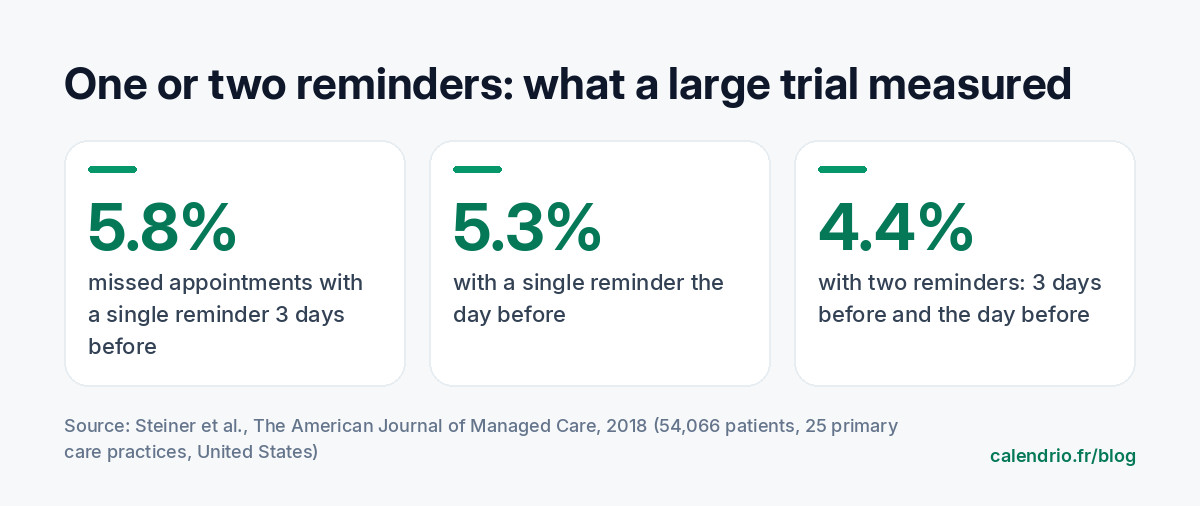
The most solid research on the subject is a randomized trial published in 2018 in the American Journal of Managed Care by John F. Steiner and colleagues. It covers 54,066 patients from 25 primary care practices in the United States, randomly split into three groups:
| Group | Missed appointments |
|---|---|
| A single reminder, 3 days before | 5.8% |
| A single reminder, the day before | 5.3% |
| Two reminders, 3 days before and the day before | 4.4% |
Two takeaways. First, the gap between a single reminder three days before and a single reminder the day before is small. Second, two reminders do better than one, and the authors note that patient satisfaction did not drop with the extra reminder. Among patients identified as most at risk of not showing up, the rate falls from 24.2% with a single reminder the day before to 20.5% with two reminders.
Another study, published the same year in the Journal of the Operational Research Society by Cheng Wang, Lili Deng and Yi Han, tackles the question through modeling. Their conclusion is intuitive: the earlier an appointment was booked, the earlier the reminder should go out, and the optimal moment varies from client to client.
These studies come from the health care sector in the United States. The figures don't carry over as is to a salon or a coaching practice, but the logic applies to every appointment-based business.
The method: 4 questions to choose your timing
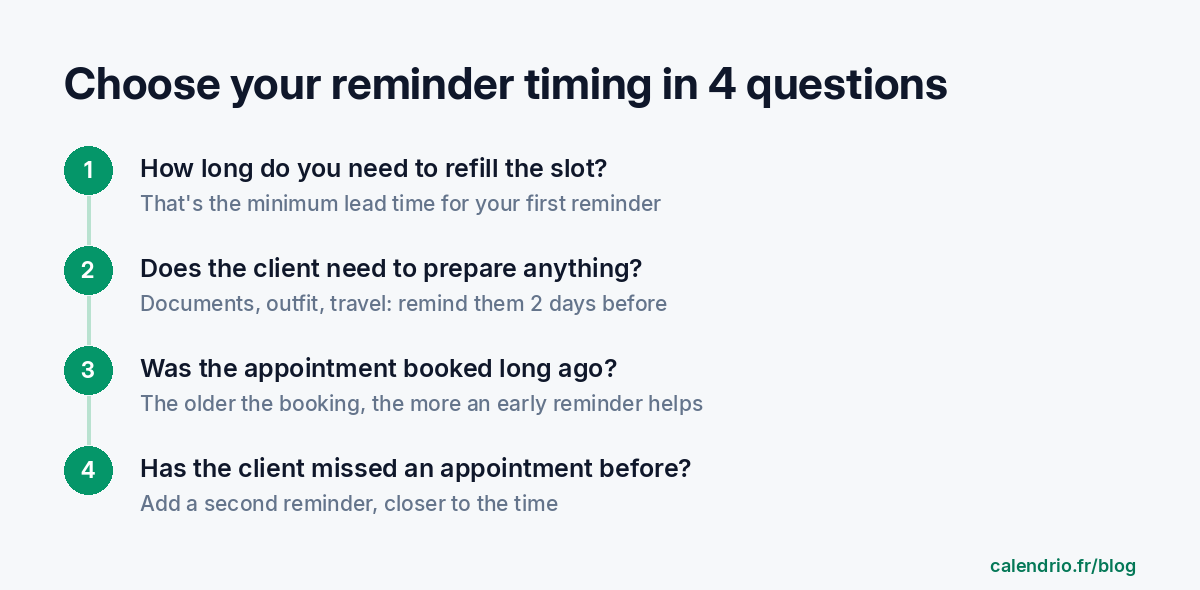
1. How long do you need to refill a time slot?
This is the most important question. If you fill a gap within a few hours thanks to a waiting list, a reminder the day before is enough. If your clients book several days ahead, a time slot freed up the day before is unlikely to be taken: move the first reminder up to two days before.
2. Does the client have anything to prepare?
Documents for a lawyer, unwashed hair for a color, workout clothes, childcare: whenever there's preparation involved, a reminder two days before gives them time to get organized.
3. Was the appointment booked long ago?
An appointment booked six weeks ago is easier to forget than one booked on Monday for Thursday. For bookings made far ahead, an early reminder helps; for an appointment booked the day before, a same-day reminder is enough.
4. Has the client missed an appointment before?
This is where the trial mentioned above shows the clearest difference. For a client who has forgotten before, add a second reminder, closer to the time.
What timing for which profession?
Applying these four questions, here are some starting points. Adjust them based on what you see in your calendar.
| Profession and situation | First reminder | Second reminder |
|---|---|---|
| Hairdresser: color or balayage | 2 days before | 2 hours before |
| Beautician: long treatment, first appointment | 2 days before | The day before |
| Coach: weekly session | The day before | Usually unnecessary |
| Wellness practitioner: first session | 2 days before | 2 hours before |
| Lawyer: consultation with documents to bring | 2 days before | 1 hour before if by video |
| Tradesperson: at-home job | The day before | The same morning |
To dig deeper into no-shows themselves, our methods to reduce no-shows cover the other levers: deposit, cancellation rule, waiting list.
The double reminder: email early, SMS late
When two reminders make sense, split the roles between channels:
- First reminder by email, 2 days before. It can be thorough: address, directions, what to bring, video link, cancellation rule. The client has time to read it and let you know.
- Second reminder by SMS, 2 hours before. Short, it can be read at a glance, right when the client needs to leave.
This pair covers both of the reminder's jobs: freeing up time slots in time, then preventing last-minute forgetfulness. To write the SMS, take inspiration from our appointment reminder SMS templates.
Reminder email template, 2 days before:
Subject: Your appointment on Thursday at 2:30 p.m.
"Hello Claire, we look forward to seeing you on Thursday at 2:30 p.m. for your color, at 12 rue des Lilas (intercom: Salon Iris). Please come with hair you haven't washed since the day before. Something came up? Cancel in one click with the link below up to 24 hours before: we'll offer the spot to a client on the waiting list. See you Thursday!"
Special cases: Monday mornings, video calls, last-minute appointments
- Monday morning appointments. A "day before" reminder goes out on a Sunday. If your clients would rather not be contacted on weekends, move it up to Friday (2 to 3 days before) and add an SMS the same morning.
- Video appointments. The client mostly needs the link at the right time: a reminder 15 minutes to 1 hour before, containing the link, prevents late log-ins.
- Appointments booked the day before or the same day. A "2 days before" reminder no longer makes sense. Keep just one reminder a few hours before.
- Very regular sessions. A client who has come every Tuesday at 6 p.m. for a year has less need for an early reminder. A single reminder, the day before or the same day, is often enough.
Measure, then adjust your timing
No timing is perfect from the start. For one month, note for each no-show or late cancellation:
- the type of service;
- the time between booking and the appointment;
- when the client let you know, if they did.
If cancellations come too late to be useful, move the first reminder earlier. If clients forget despite the reminder, add a second one closer to the time. If one type of service accounts for most no-shows, handle it separately, with a double reminder or a deposit.
How to set your reminder timing in Calendrio
In Calendrio, an email reminder goes out before every confirmed appointment, on all plans (the day before on the Free plan). On paid plans and during the trial, you choose the default timing in Settings, Business section, "Your clients' reminders" box: by email (the day before, 2 days before, 2 hours or 1 hour before) and, in addition, by SMS to mobile numbers in France, Spain, Portugal and Germany. For a specific appointment, the "Add appointment" window allows up to three reminders, from 15 minutes before to two days before, including the same morning: the "email 2 days before, SMS 2 hours before" double reminder takes just a few clicks to set up. Your clients can also choose their own timing when booking. How it all works is explained in our guide to automatic appointment reminders and on the SMS appointment reminders page.
SMS reminders are included each month in paid plans, then €0.10 excl. VAT per SMS; if the balance is empty, the reminder is sent by email. The SMS contains a link to cancel online. You can try Calendrio free for one month, with no credit card and no commitment.
- An early reminder lets you offer the time slot again; a late reminder prevents forgetting.
- In a trial of 54,066 patients, two reminders (3 days before and the day before) did better than one: 4.4% no-shows versus 5.3% and 5.8%.
- Choose your timing with 4 questions: time to refill the slot, preparation, how long ago the booking was made, past no-shows.
- For long services or at-risk clients: email 2 days before, SMS 2 hours before.
- Track your no-shows for a month, then adjust the timing by type of service.
Frequently asked questions
How far in advance should you send an appointment reminder?
Should you send one or two reminders?
How long before the appointment should an SMS reminder go out?
Should you send a reminder on Sunday for a Monday appointment?
What if your calendar filled itself?
With Calendrio, your clients book online 24/7 and receive automatic reminders. 1-month free trial, no credit card required.
Try Calendrio for free- Steiner J.F. et al. — Optimizing Number and Timing of Appointment Reminders: A Randomized Trial (The American Journal of Managed Care, 2018, vol. 24, n° 8)
- Wang C., Deng L., Han Y. — Optimal appointment reminder sending strategy for a single service scenario with customer no-show behaviour (Journal of the Operational Research Society, 2018)