Deposit (acompte) or arrhes: what should you ask clients for when they book?
Asking for a payment at booking protects your schedule from no-shows. But depending on the word you use, acompte or arrhes, your rights and your client's are not the same. Here's how to choose, and how to put it in writing.
A client books a two-hour color, a coaching assessment or a facial… then cancels the day before, or doesn't show up. To limit this risk, many self-employed professionals ask for a payment at booking. That leaves one question with real consequences: acompte or arrhes, which word should you use? In French law, these are two kinds of advance payment. The words look alike, but they don't give the same rights, either to you or to your client.
This guide explains the difference in simple terms, based on official sources, then helps you choose the right option for your profession, write your terms and apply them without upsetting anyone.
Acompte or arrhes: the difference in two sentences
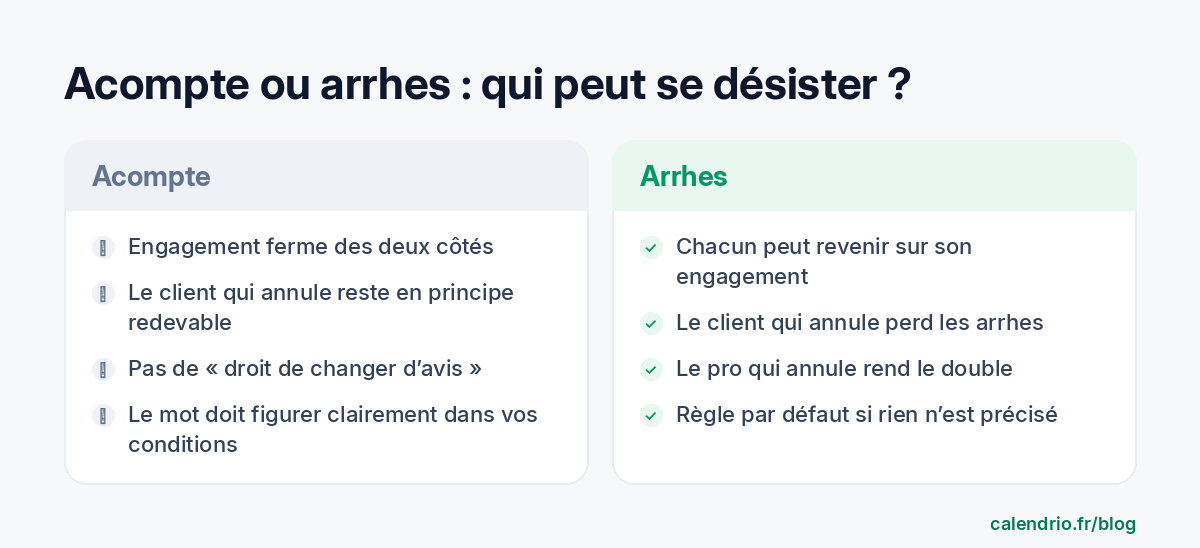
According to the practical guide from the DGCCRF (the French consumer protection authority, part of the Ministry of the Economy), an acompte is a "first payment towards a purchase": it marks a firm commitment by both parties, with no option to back out. Arrhes, on the other hand, let each party go back on their word, at a price known in advance.
In other words:
- with an acompte, the contract is concluded. The client has committed to paying for the service, and you to providing it;
- with arrhes, the contract includes a way out. The client can withdraw by giving up the arrhes; you can withdraw by paying them back double.
Both concepts apply to every appointment-based profession: hairdressing, beauty, coaching, wellness, photography, private lessons, home services.
What the law says when nothing is specified
This is the point many self-employed professionals don't know. Article L214-1 of the Code de la consommation (French Consumer Code) states that, unless otherwise stipulated, for any contract for the sale of goods or the provision of services between a professional and a consumer, sums paid in advance are arrhes. In that case, "each of the contracting parties may go back on their commitment, the consumer by losing the arrhes, the professional by paying back double".
The direct consequence: if you ask for €20 "to hold the time slot" without writing anything else, those €20 are legally arrhes. A client who cancels loses them, but owes you nothing more. And if you are the one who cancels, you owe them €40.
Two other rules are worth knowing:
- Service-public.fr (the official French government information site) states that more than three months after payment, sums paid in advance, whatever they are called, earn interest until the service is provided or the money is refunded. This mostly concerns bookings made far in advance, such as a wedding photo shoot.
- Also according to Service-public.fr, the party who withdraws may be ordered to pay damages.
These rules apply to relationships between a professional and a consumer. If your clients are businesses, as is often the case for a lawyer or a consultant, other rules may apply: have your terms checked by a legal professional.
Acompte: the firm commitment option
An acompte gives your revenue more security: a client who cancels can't simply "give up" the amount paid to be released. In practice, though, claiming the balance for an unperformed service from a private individual is rarely simple, and rarely good for the relationship.
An acompte makes the most sense when you incur costs or block a lot of time for a specific client:
- photographer: a wedding date booked months in advance, which you then turn down for other clients;
- tradesperson: materials ordered specially for a job;
- coach or trainer: a program of several sessions sold as a whole.
For the sum to really be an acompte, the word must appear clearly in your terms and on the booking summary. A vague wording such as "amount paid at booking" brings you back to the default rule: arrhes.
Arrhes: flexible, but they work both ways
Arrhes are well suited to short, repeated services: a haircut, a treatment, a massage, a physical therapy session not covered by health insurance, a private yoga class. The client knows exactly what they risk by canceling, and you keep some compensation for the lost time slot.
Their limit: the rule also works against you. If you cancel an appointment for personal convenience, you must pay back double the arrhes. So set out in your terms how you handle your own unexpected events, for example by offering a new date first.
Watch the balance too. The DGCCRF lists among presumed unfair terms a clause that allows the professional to keep the sums paid when the consumer withdraws, without providing the consumer with equivalent compensation, or double, when it is the professional who withdraws. A clause that imposes on the client "compensation of a manifestly disproportionate amount" appears on the same list.
How to choose for your profession
There is no universal right answer. Here is a grid to help you decide, service by service:
| Situation | Option that often fits | Why |
|---|---|---|
| Haircut, blow-dry, waxing, one-hour massage | Arrhes or nothing | Time slot easy to fill, client often a regular |
| Color, highlights, long treatment, first session | Arrhes | Long time slot, new client, costly no-show |
| Photo shoot or event booked long in advance | Acompte | Date blocked, other requests turned down |
| Coaching program or package of sessions | Acompte | Long-term commitment, tailored preparation |
| Tradesperson's job with materials ordered | Acompte | Costs incurred before the job |
A hairdresser might ask for nothing for a men's cut, arrhes for a color, and keep the acompte for wedding packages. The key is to be consistent and to say so before the booking.
How much should you ask for?
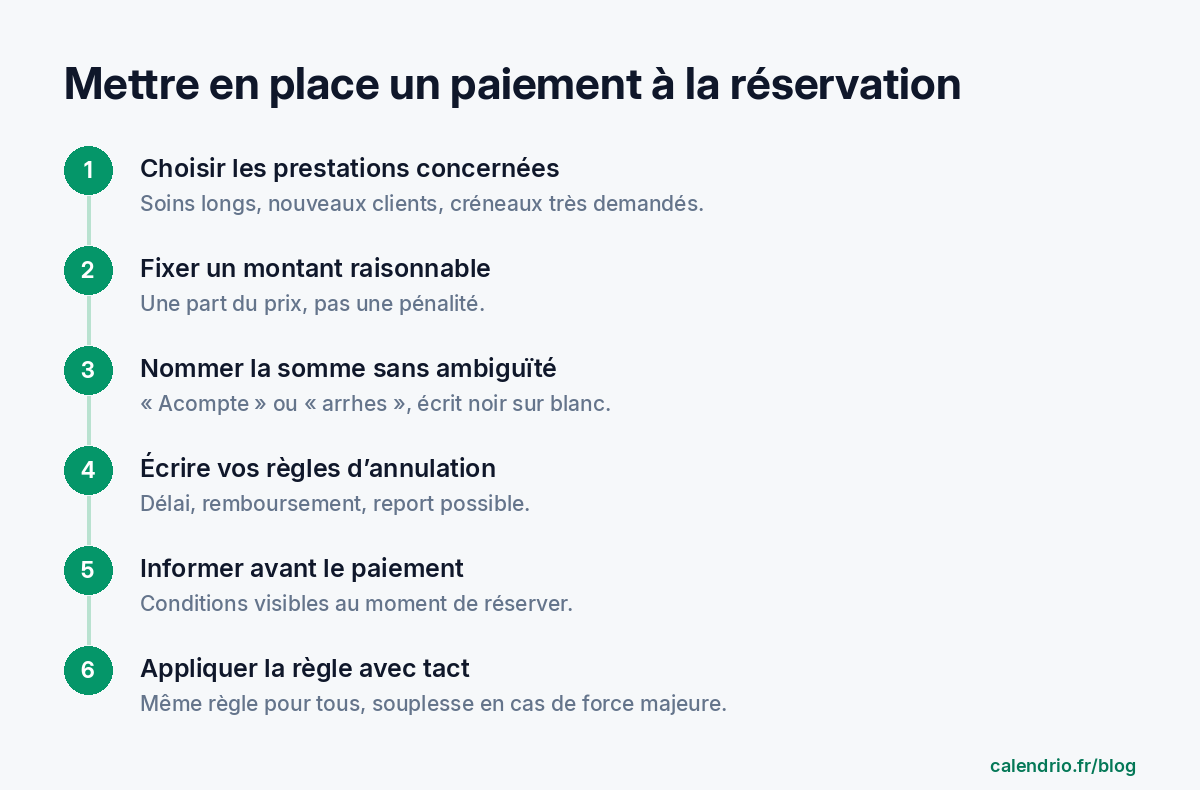
No law sets an amount for the arrhes or acompte on an appointment-based service. The right approach: an amount that makes up for part of the lost time slot, without looking like a penalty. An amount that is too high discourages bookings and, if it is manifestly disproportionate, can cause problems.
A few practical guidelines, to adapt to your clientele:
- work out what a no-show on this service really costs you (time blocked, products prepared);
- ask for a share of the price rather than the same fixed amount for everything, so it stays proportionate;
- round to an easy-to-read amount: the client should understand in one second what they risk;
- always deduct the amount from the final price: arrhes and acompte are not extra fees.
Writing your booking terms
Your terms must clearly answer four questions: what kind of payment is it (acompte or arrhes)? Until when can the client cancel or reschedule? What happens to the money in case of late cancellation or a no-show? What happens if you are the one who cancels? Display them at the time of booking, before payment, and repeat them in the confirmation email.
Template to adapt (arrhes):
"To confirm your appointment, we ask you to pay arrhes of €[amount], deducted from the price of the service. You can cancel or move your appointment free of charge up to [notice period] hours before: the arrhes are then refunded. In case of a later cancellation or a no-show, they are kept. If we have to cancel your appointment, we will offer you a new time slot or, if you prefer, pay you back double the arrhes, in accordance with article L214-1 of the Code de la consommation."
Template to adapt (acompte):
"Your booking for [service] on [date] is confirmed by payment of an acompte of €[amount], deducted from the total price of €[price]. This acompte is a firm commitment on your part and ours. The rescheduling and cancellation terms are set out below."
These templates are starting points. For a regulated activity, expensive services or business clients, have your terms reviewed by a lawyer, an accountant or your professional body.
Applying the rule without losing the client
A cancellation policy is only useful if it is applied. But it is there to protect your schedule, not to punish. A few habits that help:
- remind clients of the rule before the appointment: a reminder the day before that mentions the cancellation deadline prevents many misunderstandings;
- offer to reschedule first when the client lets you know late but in good faith: you keep the client and often the revenue;
- apply the same rule to everyone, and note the exceptions you grant (illness, family emergency) so you stay consistent;
- stick to the facts in your messages: "As stated at the time of booking, the arrhes are kept for a cancellation less than 24 hours before."
Message to copy after a no-show:
"Hello [first name], we didn't see you at your [time] appointment today. As set out in our terms, the arrhes paid are kept. If you'd like to book again, here is the link: [link]. See you soon!"
To go further, a deposit is only one of the levers against no-shows: reminders, easy cancellation and a waiting list also play a big part, as explained in our guide to reducing missed appointments.
- Unless specified otherwise, a sum paid in advance by a consumer is legally arrhes (article L214-1 of the French Consumer Code).
- Arrhes: a client who cancels loses them, a professional who cancels pays them back double.
- Acompte: a firm commitment on both sides, best kept for long or expensive services, or those booked far in advance.
- Choose service by service, with a proportionate amount deducted from the final price.
- Write your terms down in black and white, display them before payment and apply them tactfully.
How Calendrio helps you ask for a deposit
In Calendrio, payment at booking is set service by service: in "My services", you turn on the online deposit and choose a percentage of the price, between 10 and 90%. In "Booking and cancellation", you set the cancellation deadline and specify whether the amount is refunded for a cancellation made in time. Your clients book online by themselves, 24/7, and pay the amount requested when they book. If you're comparing several tools, our article on the criteria for choosing appointment booking software can help; hairdressers, also see what booking software should do for a salon.
You can test these settings on your own services with the Calendrio free trial, with no credit card and no commitment. Just remember to use in your terms the exact word, acompte or arrhes, that matches your choice.
Frequently asked questions
What is the difference between an acompte and arrhes?
If I didn't specify anything, did I ask for an acompte or arrhes?
Can you keep the arrhes if the client cancels?
What happens if I'm the one who cancels the appointment?
What if your calendar filled itself?
With Calendrio, your clients book online 24/7 and receive automatic reminders. 1-month free trial, no credit card required.
Try Calendrio for free- DGCCRF (economie.gouv.fr) — Acompte, arrhes, avoir
- Service-public.fr — Acompte, arrhes, dépôt et avoir : quelles différences ?
- Code de la consommation — Article L214-1 (texte en vigueur, reproduit par Pappers Justice)
- DGCCRF (economie.gouv.fr) — Clauses abusives : 12 clauses interdites et 10 clauses dont il faut démontrer la légitimité