Wellness practitioner invoices as a micro-entrepreneur: the receipt required above €25
Many practitioners think they only owe an invoice to clients who ask for one. Yet for a session sold to an individual for more than €25 incl. VAT, a receipt is mandatory. When to hand it over, what to put on it, and how to issue it straight from the appointment rather than redoing it in the evening.
Take a sophrologist working as a micro-entrepreneur in France, who charges €60 for her individual sessions. Like many practitioners, she thinks she only owes an invoice to clients who ask for one. Yet for a service worth more than €25 incl. VAT sold to an individual, a receipt is mandatory, even if nobody asks for it. So a wellness practitioner's invoice as a micro-entrepreneur is not a year-end formality: it goes with almost every session.
Here is when to hand it over, what it must show, and how to issue it from the appointment itself rather than copying it out in the evening.
Individual or business: when an invoice is required
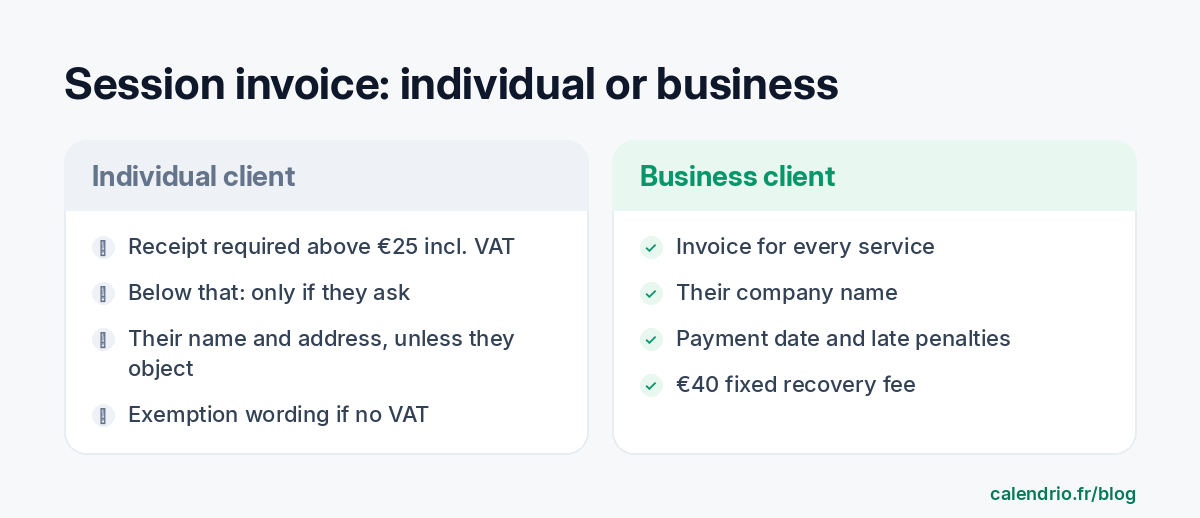
The rule depends on your client. According to the invoicing page on service-public.gouv.fr (checked on 7 August 2026), a receipt must be given to an individual when the service exceeds €25 including VAT. Below that, it is optional, but becomes mandatory if the client asks for it.
For a business client, an invoice is required for every service, in principle when it is performed. That is the case for a company offering stress-management sessions to its employees, a school that brings you in, or a spa that subcontracts massages to you.
What a wellness practitioner's invoice must show as a micro-entrepreneur
Service-public.gouv.fr lists the main required details. For a micro-enterprise, they fit in a few lines:
- A unique number, in a continuous sequence with no gaps.
- The issue date and the date of the session.
- Your identity: first and last name followed by “EI” or “Entrepreneur individuel” (sole trader), your address and your SIREN number.
- Your client: for an individual, their full name and address, unless they object; for a business, the company name.
- The service: precise description, quantity, unit price and total.
- The VAT exemption wording, if you don't charge VAT.
- For a business client: the payment date, late payment penalties and the €40 fixed debt-collection fee.
For the description, write what you sell, without promises: “Individual sophrology session, 60 min” rather than “Session to beat anxiety”. An invoice is also a document others will read. Invoices must then be kept for ten years. Your SIREN is the first 9 digits of your SIRET.
Sample lines to copy
First Name Last Name EI — [your practice address] — SIREN [your 9 digits]
Invoice no. F-2026-0042 dated 13/11/2026
Client: [client's first and last name]
Individual sophrology session (60 min) on 12/11/2026 — 1 × €60.00 — Total: €60.00
VAT not applicable (exemption wording: see the VAT section below)
Paid on 12/11/2026 by bank card.
This sample is a layout example, not tax advice: check your own situation (VAT, mixed activity, client abroad) with your accountant or your business tax office.
How can I handle my invoices without spending my evenings on them?
By issuing each invoice from the appointment, at the time of payment, instead of redoing it in the evening from a notebook. The appointment already contains the client, the service, the date and the price: all that is left is the number. Here is our sophrologist's week with Calendrio, whose automatic invoices are included in the paid plans and during the trial.
Once and for all: your details
In the “Invoices” menu, she enters her name followed by “EI” (the field suggests it: “E.g.: Marie Dupont EI”), her address and her 14-digit SIRET, then chooses “I don't charge VAT”. As long as these details are missing, no invoice can be created: that is intentional. She also ticks “Send the invoice to the client by email automatically”, which is off by default.
Monday: a session from a programme, paid online
A client is following a programme of several sessions to prepare for an exam. She books the third one and pays online by card. The invoice is created automatically after payment, with the next number, for example F-2026-0039, and is sent by email. If the client has only paid a deposit, the invoice shows it along with the balance due.
Wednesday: a session paid at the practice
A client pays by cheque at the end of his session. She opens the appointment in her calendar and taps the “Invoice” button: the “Invoices” page opens on that appointment. She clicks “Create the invoice” and ticks “Already paid on site”. Forgotten sessions don't get lost: the page lists “Appointments in November without an invoice”.
Thursday: a corporate session
A small business asks her for a stress-management workshop for its team. Here, an invoice is required whatever the amount, with the payment date, late payment penalties and the €40 fee. As the Calendrio invoice has no field for the client's SIRET, she issues it with her invoicing tool (see the limits below).
At the end of the month: the export
She picks the month in “Invoices” and downloads a CSV file for her accountant: numbers, dates, clients, amounts, VAT and payment methods. Each invoice can be viewed, printed or saved as a PDF from the browser. Its content is locked when issued: only the payment status can change afterwards.
Calendrio's Free plan, for its part, does not create invoices. Invoices issued during a subscription or a trial remain available if you go back to it.
When a calendar is not enough
A booking tool is not full invoicing software. Here are Calendrio's limits, worth knowing before you rely on it:
- Business client: the invoice shows their name and email, but has no field for their SIRET or VAT number. For your corporate sessions, an invoicing tool is a better fit.
- Client address: it only appears for a home visit. If an individual client wants their address on the invoice for a session at your practice, issue it with another tool.
- Cancellation after invoicing: Calendrio does not create credit notes. The invoice stays in place; the credit note is done with your accounting tool.
- Gift cards and packages: their sale has no invoice of its own. The part paid with a code appears on the session invoice and in the export. Ask your accountant how to handle the sale itself; how the cards work is explained in the article on gift cards for independents.
- Language: the invoice and the export are in French, even for a client who booked in another language.
VAT wording and e-invoicing: what is changing
Two changes are under way, and they also concern micro-enterprises that don't charge VAT.
The exemption wording. VAT is moving from the French General Tax Code (CGI) to the Code of taxes on goods and services (CIBS). On Légifrance, article L. 233-3 of the CIBS, which defines the exempt business, comes into force on 1 January 2027 (ordinance no. 2026-671 of 27 July 2026). The official sources do not say the same thing, though: the service-public.gouv.fr page (checked on 7 August 2026) gives the wording “TVA non applicable, art. L. 223 et s. du CIBS” since 1 September 2026, with the old reference still accepted until 31 December 2027. Before changing your invoices, have your accountant confirm the exact wording. Today, Calendrio writes “TVA non applicable, art. 293 B du CGI”; the “Note at the bottom of the invoice” field lets you add a line if you are advised to.
E-invoicing. According to the DGFiP leaflet for micro-enterprises (May 2026), you have been receiving e-invoices since 1 September 2026. By 1 September 2027 at the latest, you will issue your invoices to businesses in electronic format through an approved platform, and you will transmit data on your sales to individuals (e-reporting). For your individual clients, e-reporting applies, not e-invoicing. Calendrio is not an approved platform: choose one before then.
- For an individual, a receipt is mandatory above €25 incl. VAT, and on request below that.
- For a business, an invoice for every service, with the payment terms.
- Name followed by “EI”, SIREN, continuous numbering and exemption wording: check these lines once.
- Issue the invoice from the paid appointment, not from a notebook redone in the evening.
- VAT wording and e-invoicing: review them with your accountant and choose an approved platform before 1 September 2027.
What Calendrio brings to your invoices
Calendrio creates the invoice for a session paid online, invoices a session paid at the practice in one click, numbers without gaps and prepares the monthly export. These automatic invoices after appointments are included in the paid plans (Pro at €39 excl. VAT per month) and in the trial. Other tools designed for your profession are on the wellness practitioners page.
Try them on your November sessions: until 30 November 2026, this link extends the one-month trial to three months, with no bank card and no commitment.
Frequently asked questions
How can I handle my invoices without spending my evenings on them?
Do I have to issue an invoice if my client doesn't ask for one?
Which VAT wording should I put on my invoices?
Is it free? Where does the free plan stop?
What if your calendar filled itself?
With Calendrio, your clients book online 24/7 and receive automatic reminders. 1-month free trial, no credit card required.
Try Calendrio for free- Entreprendre.service-public.gouv.fr — Tout savoir sur la facturation (vérifié le 07/08/2026, consulté le 13/11/2026)
- Légifrance — Article L233-3 du Code des impositions sur les biens et services, version en vigueur au 01/01/2027 (ordonnance n° 2026-671 du 27 juillet 2026, consulté le 13/11/2026)
- DGFiP — La facturation électronique, dépliant pour les micro-entreprises (mai 2026, consulté le 13/11/2026)