Gift cards for independent professionals: how to create, sell and redeem them
A gift card brings in money before the service is delivered and attracts new clients. Here is how to set one up in six steps: format, validity period, terms, online sales, promotion and code tracking, plus the VAT questions to ask your accountant.
Christmas, Mother's Day, birthdays: every year, clients look for a gift that will delight and won't gather dust. A massage, a facial, a haircut, a coaching session or a workshop has everything going for it. A gift card for independent professionals meets this demand: your client pays today, and the person who receives it comes to discover your work later.
You still need to prepare it properly: what amount to offer, how long it stays valid, how to avoid lost codes and forgotten cards, and what to ask your accountant. This guide gives you a complete method, text templates to copy and examples by profession.
Why offer a gift card as an independent professional?
A gift card has three concrete advantages for a professional who works by appointment:
- It brings in money before the service. At the end of the year, often a period of heavy spending, this is welcome cash flow.
- It brings in new clients. The person receiving the gift may not have known you. If they enjoy the experience, they will come back and pay for themselves.
- It rewards your regulars. Your regular clients are your best ambassadors: they give what they have enjoyed.
It isn't just for beauty salons and spas. A coach can offer "3 sessions to get started", a photographer a portrait session, a craftsperson an introductory workshop, a wellness practitioner a first discovery session.
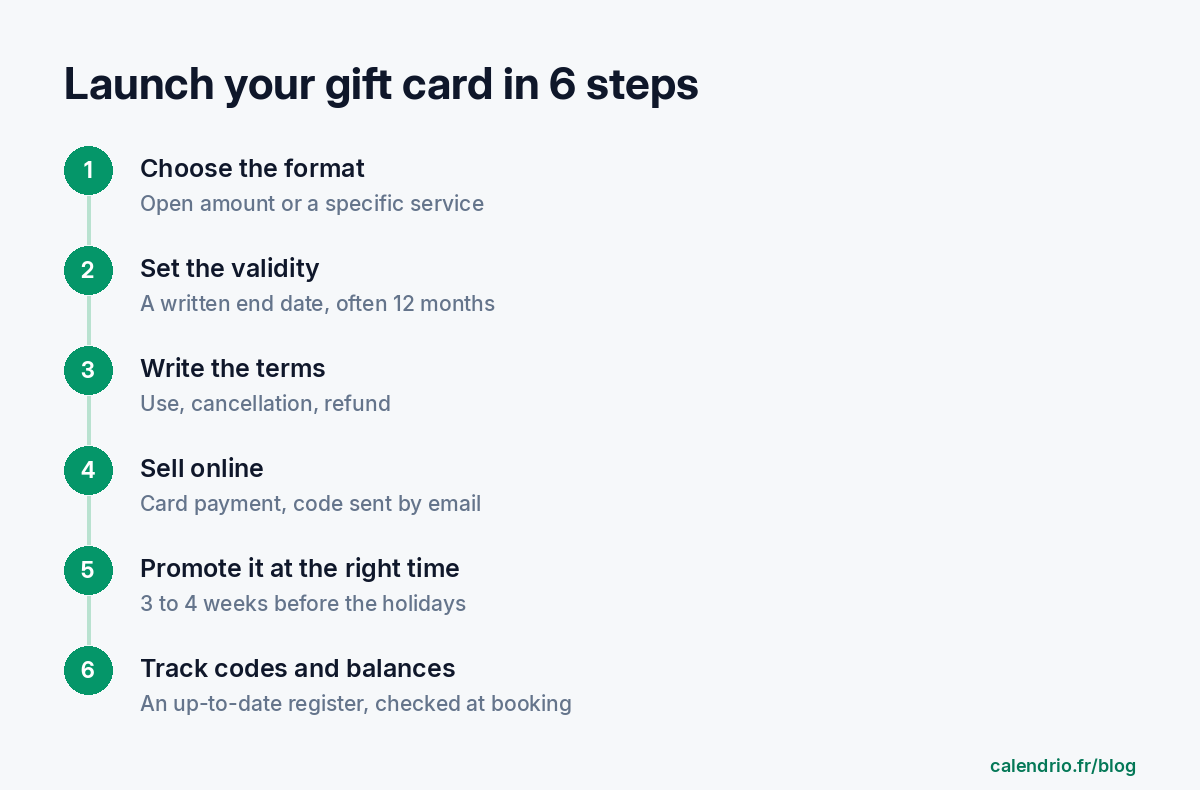
Step 1: choose between a set amount and a specific service
There are two formats, and they are not managed the same way:
| Amount card | Service card | |
|---|---|---|
| Example | €50 gift card | "A 60-minute facial" |
| For the recipient | They choose what they want | They know exactly what to expect |
| For you | Easy to sell, balance to track | Fixed price, to review if your rates change |
| Ideal for | Hairdresser, beautician, beauty salon | Massage, coaching, photo shoot |
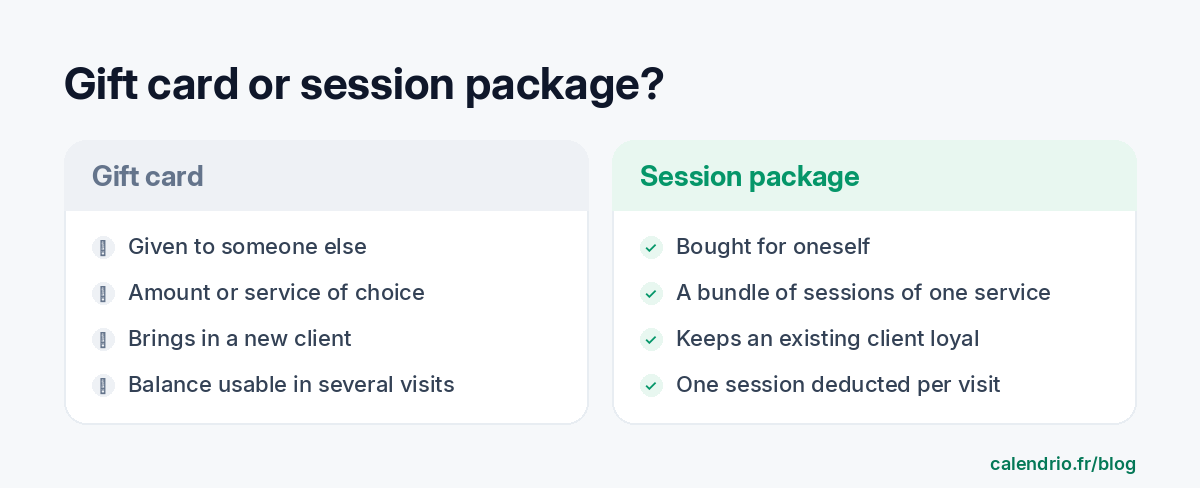
A free amount is more flexible. Offer three or four tiers that match your actual services: for example, a haircut, a treatment, a full treatment. The recipient can use their balance over several visits if they don't spend it all at once.
A close variant is the session package: the client buys a bundle of sessions for themselves (5 or 10, for example), which are deducted appointment by appointment. It is more of a loyalty tool than a gift, but it sells the same way. For your prices, rely on our method to set your rates: a discounted package should never fall below your minimum price.
Step 2: set a clear validity period
A gift card almost always has an end date. In France, most retail gift cards are valid for 12 months from purchase, according to a survey published by MoneyVox; some last two, three years or more. For an independent professional, one year is a common period, which gives the recipient time to find a slot.
What matters is that the date is written in black and white, on the card and in the email, to avoid any dispute. If you have doubts about your disclosure obligations, check with your local chamber of commerce or a legal advisor.
Step 3: write simple terms
A few lines are enough, printed on the card or at the bottom of the email:
Terms template to copy:
"Gift card valid for 12 months from the date of purchase, until [date]. Can be used on all services at [your business], in one or several visits. Book online at [your link] and enter the code. Non-refundable. If the appointment is cancelled late, our usual cancellation terms apply."
Think about cancellations: if the recipient doesn't show up for the appointment, what happens to the session? Apply the same rules as for your other clients, and say so. Our cancellation policy template helps you put them into words.
Step 4: sell it online, not just in person
Many buyers decide late, in the evening, sometimes the day before the birthday. If the card can only be bought at the counter or by bank transfer after an exchange of messages, you lose these last-minute sales.
An online sales page solves the problem: the buyer chooses the amount, pays by card and receives the code by email immediately. If they enter the recipient's address, the recipient gets their gift directly with a short message. You have nothing to print or send.
Still keep a paper version for the counter: a nice card with the code handwritten on it pleases those who want to give something tangible.
Step 5: promote it at the right time
A gift card sells mainly when people talk about it. The key moments are well known: Christmas, Valentine's Day, Mother's Day, Father's Day. Start promoting three to four weeks ahead, then follow up in the final week, when latecomers are looking for an idea.
- A post on your social media with the link to the sales page.
- A small sign at the till or in your waiting room.
- An email to your existing clients, who already know your work.
- A line in your Google profile: "Gift cards available online".
Holiday message template:
"Looking for a Christmas gift idea? Give a moment at [your business]: gift cards from €30 to €100, valid for one year, to buy online in two minutes. The code arrives by email right away, and you can send it directly to the person of your choice: [link]."
To reach your regular clients without wearing them out, one well-timed email is enough. Our guide to building client loyalty gives more ideas for staying in touch all year round.
Step 6: track codes and balances
The classic trap: a lost paper card, a code used twice, a €12 balance nobody remembers. Keep a register, even a simple one, with for each card:
- the unique code and the purchase date;
- the initial amount and the remaining balance;
- the expiry date;
- the date and the service of each use.
When the recipient books, ask for their code at the time of booking, not on the day. That way you check its validity in advance and avoid surprises at reception.
Gift cards and VAT: the questions to ask your accountant
If you are under the VAT franchise scheme (mention "TVA non applicable, art. 293 B du CGI"), VAT does not apply to your sales. If you charge VAT, French tax doctrine distinguishes two types of vouchers, described in the Bulletin officiel des finances publiques (BOI-TVA-CHAMP-10-10-40-50, article 256 ter of the CGI):
- The single-purpose voucher: at the time of sale, you know which service will be provided, where, and at what VAT rate. This is the case for a card valid for a number of sessions at a given location. VAT is due as soon as the voucher is sold.
- The multi-purpose voucher: at the time of sale, one of the taxation details is not known. The sale of the voucher is then outside the scope of VAT, which is only due when the service is provided.
A card for a free amount, usable on services subject to different rates, is therefore not necessarily treated like a "one facial" card. Have your case confirmed by your accountant before you start selling: they will also tell you how to record cards sold and those that expire unused.
Mistakes to avoid
- Offering amounts that match nothing: a €40 card when your services cost €35 or €55 creates balances that are hard to use.
- Forgetting the validity date: without a written date, you risk disputes years later.
- Not planning for capacity: if you sell many cards in December, keep free slots in January and February to welcome them.
- Neglecting the first appointment: the recipient is discovering your work. Take care of the welcome, and offer to book their next appointment at the end of the session.
- A gift card brings in money before the service and attracts new clients.
- Choose between a free amount (flexible) and a specific service (more concrete).
- Write a clear validity date: 12 months is the most common period in France.
- Sell it online with instant delivery of the code, and keep a paper version at the counter.
- Promote it 3 to 4 weeks before the holidays, then follow up in the final week.
- Keep a register of codes and balances, and have VAT confirmed by your accountant.
How Calendrio helps you sell your gift cards
With the Pro and Team plans, and during the trial, Calendrio gives you a "Gift" page where your clients buy a gift card or a session package online. You choose your amounts in Settings, the buyer pays by card, the money goes to your own Stripe account, and the code is sent immediately by email, with a message to the recipient if the buyer wishes. The card is valid for 12 months; the recipient enters their code when booking, the amount is deducted and the balance remains available for next time.
You can try all these features with the free one-month trial, no credit card and no commitment. Plan details are on the Pricing page.
Frequently asked questions
How long should a gift card be valid for?
Is it better to offer a gift card for an amount or for a specific service?
Do you have to charge VAT on a gift card?
How can independent professionals sell gift cards online?
What if your calendar filled itself?
With Calendrio, your clients book online 24/7 and receive automatic reminders. 1-month free trial, no credit card required.
Try Calendrio for free