Setting your rates as a self-employed professional: a step-by-step method
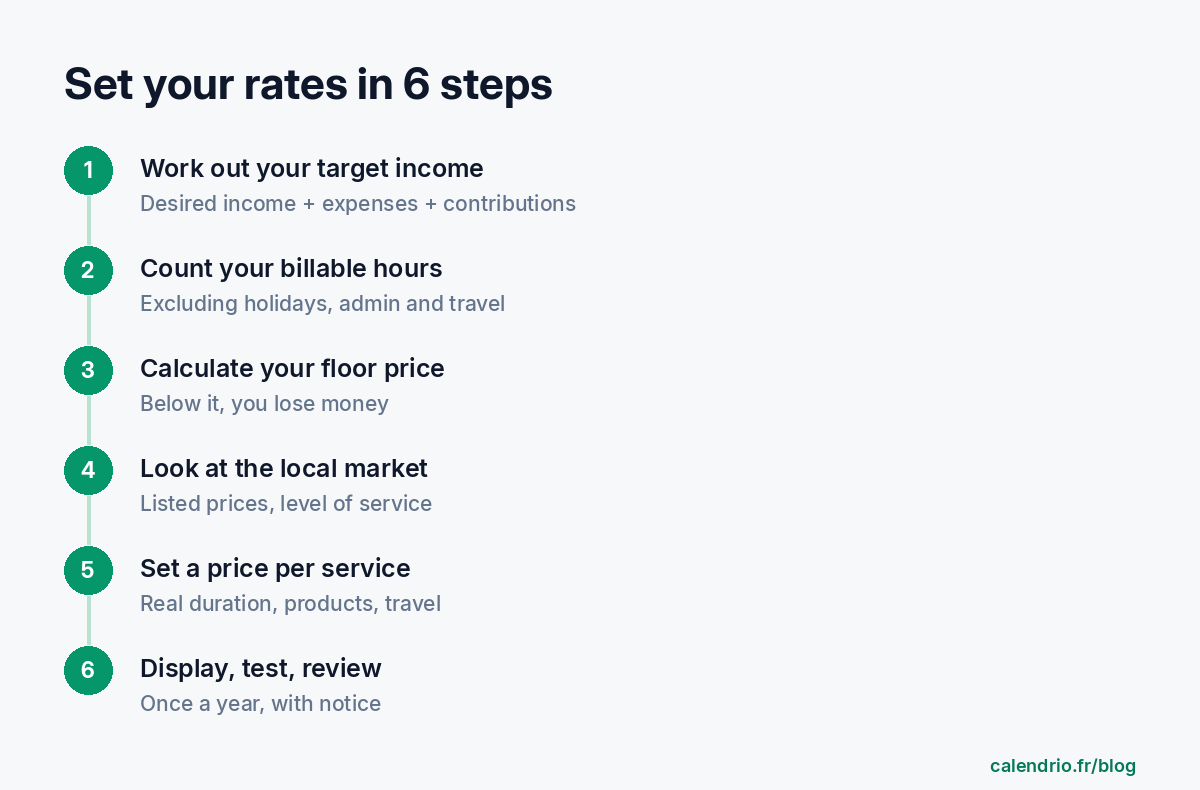
A price picked "by eye" can fill your calendar without keeping your business afloat. Here is a six-step method to set your rates from your real figures, a complete worked example, the price display rules you need to know and ready-to-copy templates to announce a price increase.
How much should you charge for a session, a haircut, a call-out or an hour of advice? Many self-employed professionals pick a price "by eye", looking at what the person next door charges. The risk: a full calendar and a bank account that doesn't keep up. To set your rates without getting it wrong, start from your own figures, and only then look at the market. This guide gives you a six-step method, a complete worked example and templates to copy for announcing your prices.
The method works for every appointment-based trade: hairdresser, beautician, physiotherapist, coach, wellness practitioner, lawyer, tradesperson. It does not replace the advice of an accountant or your social contributions body, who know your exact situation.
Why pricing "by feel" costs you dearly
A price that is too low doesn't show straight away. It shows at the end of the year, when you add up social contributions, rent, products, insurance, phone and weeks of holiday. It also shows in fatigue: to make up for it, you add appointments, cut into your breaks and no longer have time for training.
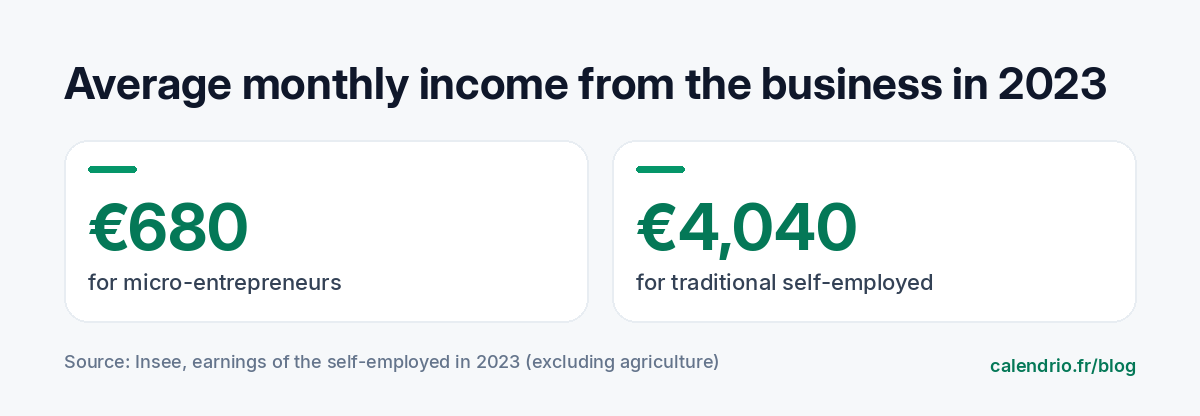
According to Insee, the French statistics office, in 2023 micro-entrepreneurs earned on average 680 euros a month from their self-employed activity, compared with 4,040 euros for conventional self-employed workers (excluding agriculture). This average mixes very different situations, but it is a reminder of one thing: turnover is not income. Your price has to cover everything your business costs before it pays you.
Step 1: put a figure on the income you need
Start from what you want to pay yourself each month to live on. Then add everything the business has to pay for over a year:
- fixed costs: premises or share of rent, professional insurance, bank, phone, software, accountant;
- variable costs: products, consumables, fuel, equipment that wears out;
- social contributions and tax: the rate depends on your status and your activity. Check it with the official contributions body (Urssaf in France) or your accountant rather than reusing a figure you read somewhere else;
- a reserve for the unexpected, quiet months and investment (training, new equipment).
The total gives you the annual turnover you need to reach. That is your real target, far more useful than a price found on the internet.
Step 2: count your truly billable hours
A year does not have 52 working weeks. Take out holidays, public holidays, training and a margin for sick days. Then, in each week, take out the time nobody pays you for: bookkeeping, messages, social media, purchasing, cleaning, travel between two clients.
At this step, many self-employed people discover that they only bill part of their working time. To measure this hidden time, write down what you do hour by hour for a week. Our method to organise your week as a self-employed professional helps you group these tasks and protect your paid hours.
Step 3: calculate your minimum price
Divide the turnover you need by the number of billable hours: you get your minimum hourly rate. Then, for each service, add its direct costs (products used, travel). Below this minimum price, every appointment costs you money.
Here is a fictional worked example, to show the calculation. Replace each line with your own figures.
| Calculation line | Fictional example |
|---|---|
| Annual turnover needed (income + costs + contributions + reserve) | €45,000 |
| Weeks worked (52 minus holidays, public holidays, training, sick days) | 45 weeks |
| Billable hours per week (out of 38 hours of work in total) | 25 h |
| Billable hours in the year (45 × 25) | 1,125 h |
| Minimum hourly rate (45,000 ÷ 1,125) | €40 an hour |
| 1 h 15 session including setup and tidying, plus €3 of products | €53 minimum |
This minimum is not necessarily your price. It is the line you should not go below, even for a promotion.
Step 4: look at the market, without copying it
Write down the prices displayed by five to ten professionals near you: same trade, same area, comparable clientele. Also note what is included: actual duration, assessment, advice, products, follow-up between sessions, the option to book online at any time.
There are three possible cases:
- your minimum is below market prices: you have room to manoeuvre, position yourself according to your experience and your service;
- your minimum is around the average: focus on what sets you apart so you are not compared on price alone;
- your minimum is above market prices: review your costs, your billable hours or your offer (longer services, packages, a different clientele) rather than working at a loss.
Step 5: set a price per service, not just per hour
Your clients buy a result, not minutes. A price per service is easier to read and lets you include what the hourly rate leaves out: setup, cleaning, products, the summary sent after the session.
Hairdresser: distinguish cut, colour and highlights, as colour uses more product and processing time. Beautician: a 60-minute facial and a 15-minute wax do not have the same treatment-room cost. Physiotherapist or wellness practitioner: count the time spent on handover and notes after each session. Personal trainer: one-to-one, duo and group sessions each have their own price, and a ten-session package can secure your quarter. Lawyer or consultant: a fixed-price first appointment reassures clients and makes the decision easier. Tradesperson: separate labour, materials and travel costs, and state the area you cover.
For long services or time slots in high demand, asking for a deposit protects your time: our article deposit or down payment explains the difference and what it changes in the event of a cancellation.
Step 6: display your prices and follow the rules
For services, France's consumer protection authority (DGCCRF) points out that the list of services offered and their prices must be displayed where clients are received, legible and visible to the public. Prices for private individuals are stated in euros including all taxes. If you offer many services, the display can take the form of a catalogue made available to clients.
Two points are often forgotten. If you charge for a quote, you must say so before drawing it up. And additional costs known in advance (travel, surcharge) must be announced before the client commits. According to the French Ministry of the Economy website, failing to meet these price information obligations can lead to an administrative fine of up to 3,000 euros for a sole trader and 15,000 euros for a company. If you are unsure about your situation, check with the DGCCRF or a legal professional.
How do you raise your rates without losing your clients?
A price can be revised. Your costs go up, and so does your experience. Reviewing your rates once a year, on a fixed date, avoids sudden increases. A few simple rules:
- Give notice: a month ahead, by message to your clients and on your booking page.
- Explain without justifying yourself: one sentence on what has changed (products, training, new equipment) is enough.
- Honour existing bookings: appointments made before the announcement keep the old price.
- Offer a transition: for example, a package bought before the date keeps the old rate.
Template to copy: announcing a price increase
"Hello [First name], from [date], the price of [service] will go from [old price] to [new price]. This change allows me to [keep using quality products / train in new techniques]. Appointments already booked keep their current price. Thank you for your trust, see you very soon! [Signature]"
Template to copy: replying to "that's a bit expensive"
"I understand. This price includes [actual duration], [assessment or personalised advice] and [follow-up or product included]. If you would rather start more simply, I can offer you [shorter service] for [price]."
Keeping your clients after an increase depends above all on the relationship: our methods to build client loyalty give you practical steps.
Mistakes to avoid
- Copying the cheapest competitor's price: their costs, status and hours are not yours.
- Forgetting invisible time: setup, tidying, messages and travel are part of the cost of an appointment.
- Piling up discounts: a permanent discount becomes the real price in the client's mind.
- Never reviewing: a price frozen for years loses value every time your costs go up.
- Hiding your prices: on top of the display rules, a visible price saves everyone time and avoids appointments that go nowhere.
- Start from your figures: desired income, costs, contributions and reserve give you your target turnover.
- Divide it by your truly billable hours to get your minimum price.
- Then look at the local market to position yourself, without going below that minimum.
- Set a price per service that includes setup, products and travel.
- Display your prices including tax and announce additional costs before the client commits.
- Review your rates once a year, giving your clients advance notice.
How Calendrio helps you apply your rates
In Calendrio, each service has its own duration, price and payment method: on site, deposit or full payment online. You can also add travel costs per service. Your clients see your services on your booking page and book by themselves, 24/7. With the paid plans and during the trial, you can sell session packages and gift cards, and set lower prices at off-peak times or higher prices at peak times.
The Free plan lets you start with two services. To go further, the one-month free trial requires no credit card and no commitment: create your booking page and test your new rates.
Frequently asked questions
How do you calculate your hourly rate when you are self-employed?
Do service providers have to display their prices?
Is it better to charge by the hour or by the service?
How often should you review your rates?
How do you position yourself against cheaper competitors?
What if your calendar filled itself?
With Calendrio, your clients book online 24/7 and receive automatic reminders. 1-month free trial, no credit card required.
Try Calendrio for free