Prospecting explained simply: the 5-step method for the self-employed
Your clients exist, they just don't know you yet. Here is what prospecting is, the five-step method with a sample message, the rules to follow in France and what you can honestly expect from it.
Your schedule has gaps. Yet your clients exist: they just don't know you yet, that's all. Prospecting means going to them instead of waiting for them to find you.
This guide explains it simply, in five steps, with the example of Claire, a self-employed sophrologist (a made-up character) who wants to offer anti-stress workshops to businesses. For each step, a blog article goes further.
What is prospecting?
Prospecting means finding people who need you, contacting them and bringing them to a first appointment. A prospect is a potential client: they haven't bought yet, but they have a problem you know how to solve.
What prospecting is not:
- Sending the same message to 1,000 people. It's tiring, it doesn't work, and it's often illegal.
- Begging. You're not asking for a favor: you're offering a solution to a real problem.
- A one-off effort. It's a habit. A little every week beats one big day a month.
There are two kinds: prospecting businesses (a practice, a small company, a works council) and prospecting individuals. The rules are not the same, as we'll see in step 4.
The 5-step method
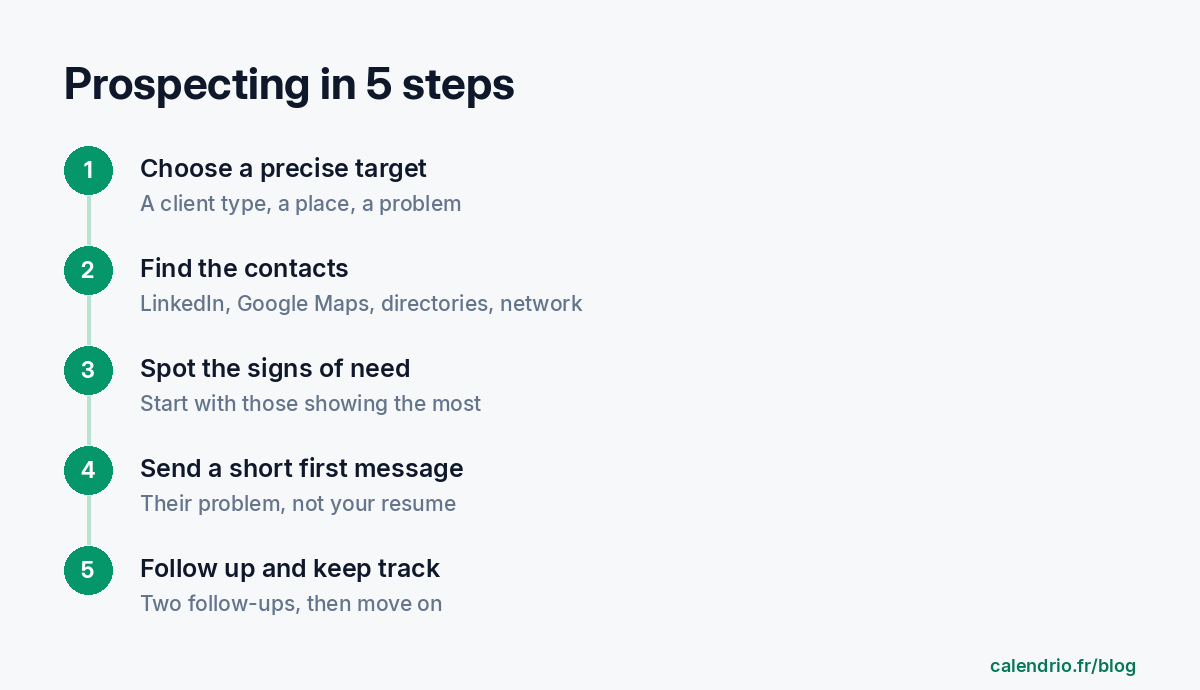
1. Choose a precise target
“Everyone” is not a target. A target is a type of client, a place and a problem. Claire chooses: small companies with 20 to 100 employees, less than 30 minutes from home, that are hiring a lot.
To do: write your target in one sentence. If you're torn between two, take the smaller one.
2. Find the contacts
Look where your target already is:
- LinkedIn for businesses (the owner, the HR person);
- Google Maps for shops and practices in your town;
- directories for your trade or the official business directory;
- your network: who knows someone at these businesses?
Claire puts each business on a list: name, contact, website and what she noticed.
3. Spot the signs of need
This is the step most people skip, and it makes all the difference. A sign of need is a public clue that the problem exists. For Claire: lots of job ads online, a recent move, a careers page that talks about team well-being.
The more signs a business shows, the more reason it has to read you. Claire contacts those with the most signs first. The full method, with a score from 0 to 4, is in our guide Qualifying your prospects.
4. Send a short first message
A good first message talks about their problem, not about you. It fits in five lines. Here is Claire's, sent to the HR manager of a small company:
Hello Ms. Martin,
You're hiring six people this month.
When a new team arrives, that's often when stress starts to rise.
I run 45-minute on-site workshops to help teams catch their breath.
If this is a topic for you, I suggest a 15-minute call on Tuesday. If not, no problem at all.
Claire
Notice: an observed fact, the problem, the solution, a simple question, a way out. No “I hope you're doing well”. Add your booking link: an interested person picks their own slot.
The rules to follow in France:
- Email to a business: allowed without prior consent, if the message relates to the person's job. Say clearly who you are and give a simple way to stop being contacted.
- Email to an individual: you need their consent first. No “cold” sending.
- Phone call to an individual: since August 11, 2026, you also need their prior consent.
The details are in B2B email prospecting: the simple method for the self-employed. For a specific case, ask a lawyer for advice.
5. Follow up and keep track
Silence is not a no: often the message just wasn't seen. Claire follows up once after a few days, with a single new sentence, then moves on.
She writes everything down: who replied, when to follow up, what was said. Without this tracking, you forget half your prospects.
What to expect, honestly
Picture a funnel: lots of contacts go in at the top, few clients come out at the bottom. That's normal. In email prospecting, it's common for a few businesses out of 100 to reply, and for 0 to 2 appointments to come out of it during the first weeks. No result can be promised: it all depends on your trade, your targets and your message.
That's why you prospect a little every week, and why the method is especially worthwhile when a single client brings in a lot: a company workshop that comes back every quarter, for example. Write down your own numbers: they show you where things get stuck (no replies = rework the target or the message; replies but no appointments = make booking simpler).
The 5 mistakes that make prospecting fail
- Talking about yourself first. Nobody cares about your background until the prospect sees their problem.
- Getting in touch without looking. A message that could be sent to anyone reads like an ad.
- Asking for too much, too soon. Suggest a 15-minute call, not a contract.
- Giving up after one silence. Without a follow-up, you lose a good share of the possible replies.
- Not preparing what comes next. The prospect says yes… then has to exchange three emails to find a slot. The momentum fades.
- Prospecting means going to the clients who need you, instead of waiting.
- Five steps: a precise target, contacts, signs of need, a short message, a follow-up.
- Talk about their problem, in five lines, with a single question and a way out.
- To businesses, email is allowed if it relates to their job; to individuals, you need their consent.
- A few replies out of 100 businesses is normal: consistency matters more than volume.
How Calendrio helps you prospect
Calendrio takes care of what happens before and after the first message, so that every “yes” becomes an appointment.
- My prospects: one record per business, with its status (to contact, contacted, replied, appointment booked, client…), your notes and an email reminder on the day you need to follow up.
- A booking link to put in every message: the prospect picks their slot, with no back-and-forth.
- A showcase page that shows who you are, your services and your reviews. Visitors can leave their email in exchange for a gift, then receive up to three messages that stop as soon as they book.
- Reminders before the appointment, and a deposit if you wish.
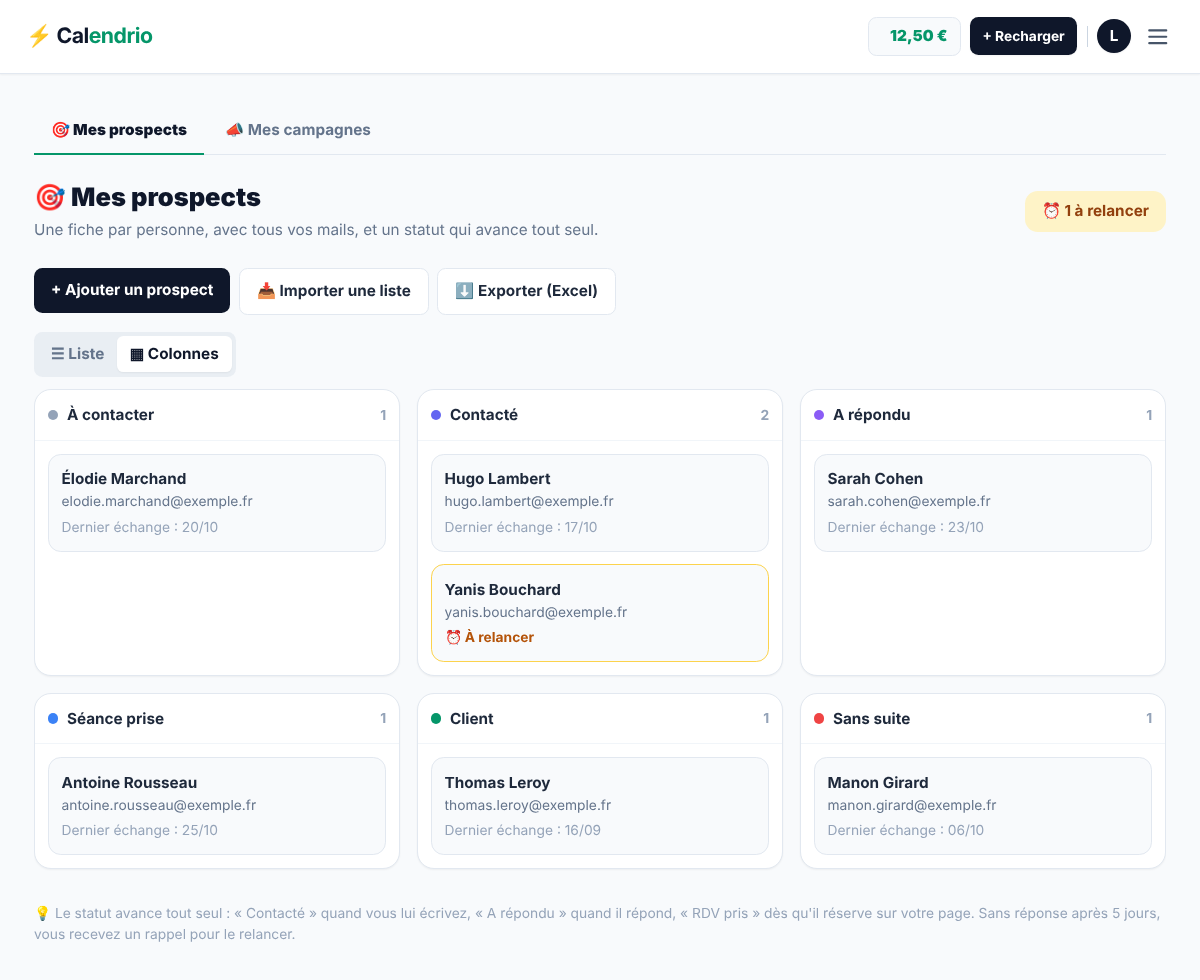
This is what's known as a sales funnel: prospecting brings people in, Calendrio guides them to the appointment.
Would you rather have someone prospect for you?
If you work with businesses and would rather spend your time with your clients, Calendrio Prospection handles steps 2 to 5 for you: a list of your targets ranked by signs of need, the text of the email and the follow-up, sending from your address, tracking of each contact and a report every Monday. You stay in control: you review the list and approve the texts before anything is sent, and replies arrive in your inbox.
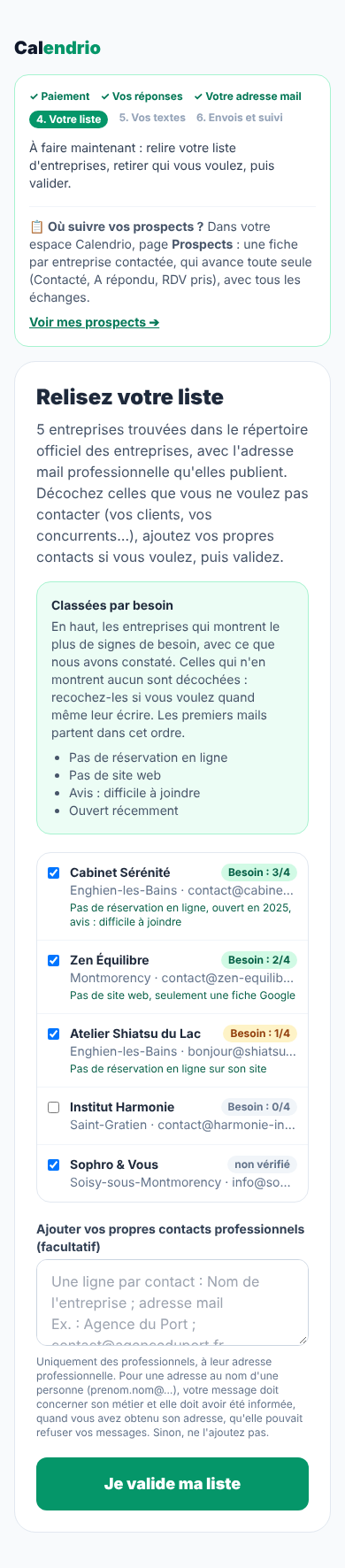
Discover Calendrio Prospection, or start with the scheduling tool: create your account with this link, 3 months free for any sign-up through this link until November 30, 2026, no credit card needed.
To go further
- You're just starting out: Finding clients when you're starting out: 9 practical actions
- Step 3: Qualifying your prospects
- Step 4: B2B email prospecting: the simple method
- After the yes: Building a sales funnel
- Where to share your link: 9 places for your booking link
— The Calendrio team
Frequently asked questions
What is prospecting, in one sentence?
How much time should you spend on it?
Are you allowed to send a prospecting email?
How many replies can you expect?
What if your calendar filled itself?
With Calendrio, your clients book online 24/7 and receive automatic reminders. 1-month free trial, no credit card required.
Try Calendrio for free